

What if your clinical worth isn't being measured by the outcomes you achieve, but by the efficiency adjustments and budget neutrality factors you've never been shown? As the 2026 Medicare Physician Fee Schedule introduces a -2.5% efficiency adjustment for non-time-based services, the methodology behind physician economic profiling has become more opaque and critical than ever before. You've likely felt the frustration of being undervalued by legacy metrics that fail to reflect your true contribution to a hospital's bottom line.
We're here to help you regain control over your professional narrative. You'll learn to master the complexities of your economic profile to understand exactly how healthcare systems quantify your clinical impact and financial value. This guide provides a clear breakdown of the data points that matter, teaching you to speak the language of administrators and prepare for rigorous, data-backed contract negotiations. It's time to move beyond the anxiety of renewals and secure a fair market value rooted in objective evidence.
Key Takeaways
- Understand why traditional wRVU metrics often fail to capture your full clinical impact in an increasingly episode-based financial environment.
- Master the core components of physician economic profiling to bridge the transparency gap between your clinical work and hospital financial reporting.
- Explore how risk adjustment models protect your profile when treating complex, high-acuity patient populations.
- Learn the strategic process of building a Value Dossier to shift from reactive conversations to data-backed advocacy during contract renewals.
- Leverage the Physician Economic Value Platform to access specialty-specific revenue analysis and objective, location-adjusted benchmarks.
What is Physician Economic Profiling in 2026?
Physician economic profiling is the systematic evaluation of a clinician's total financial impact on a healthcare system. It moves beyond simple productivity metrics to create a multidimensional view of how a physician influences an organization's fiscal health. In the 2026 landscape, this isn't just a back-office calculation; it's the primary driver for contract renewals and bonus structures. This methodology distinguishes between clinical quality profiling, which measures patient outcomes, and economic efficiency profiling, which measures the cost of achieving those results.
The industry has transitioned into what analysts call "second-generation" profiling. While first-generation models focused on preventive care counts and basic volume, today's models are episode-based. They analyze the entire cost of a care episode, from initial consultation through recovery. This shift often incorporates Economic credentialing, where a physician's right to practice within a system is tied to their ability to meet specific financial benchmarks. For the high-performing clinician, understanding this data is the difference between being viewed as a cost center and being recognized as a strategic asset.
The Core Components of an Economic Profile
A modern profile is built from three primary data pillars. First is direct revenue generation, which tracks your billable services and procedural volume. Second is downstream value, often referred to as the "halo effect." This captures the ancillary revenue you generate through referrals, imaging, and laboratory utilization. Finally, systems analyze resource utilization. This measures how efficiently you use hospital staff, surgical suites, and medical supplies compared to your peers. When these factors are combined, they provide a comprehensive view of your contribution margin.
Why Traditional Salary Surveys are No Longer Enough
Static benchmarks like MGMA data are increasingly insufficient in a dynamic, episode-based market. These surveys provide a historical look at what others were paid, but they don't reflect the specific value you generate within your unique local economy. Modern physician economic profiling accounts for geographic cost-of-living adjustments and specialty-specific overhead that broad surveys often miss. Instead of asking what the "average" surgeon makes, administrators now ask what your specific practice contributes to the system's long-term viability. Relying on outdated benchmarks during a negotiation leaves you vulnerable to one-sided data interpretations. Accessing a specialty-specific revenue analysis provides the necessary counter-data to ensure your compensation reflects your actual economic footprint.
The Evolution of Profiling: From wRVUs to Episode-Based Metrics
For decades, the Work Relative Value Unit (wRVU) served as the definitive yardstick for clinical productivity. It provided a uniform method to quantify the time, skill, and physical effort required for specific procedures. However, the healthcare industry's shift toward value-based reimbursement has exposed the wRVU as an incomplete proxy for true professional worth. Modern physician economic profiling has evolved to fill this gap, moving beyond simple task-based counts to analyze the entire cycle of care. This evolution is driven by sophisticated datasets from CMS and the RAND Corporation, which now set the benchmarks for how efficiency is measured across regional markets.
The Problem with wRVU-Only Models
The primary limitation of the wRVU is that it's a revenue-only metric. It ignores the cost side of the economic equation, such as specialized staffing, surgical supplies, and clinical space. This creates a "productivity trap" where a physician can see a high volume of patients but actually diminish the hospital's bottom line due to excessive resource consumption. High-performing clinicians often find themselves penalized by these legacy systems that don't account for the complexity of their cases or the efficiency of their workflows. While wRVUs measure effort, contribution margin measures the actual financial residue left for the system after all variable costs are covered, making it the definitive metric for high-performing clinicians. Understanding where you stand in this transition is easier when you utilize a Physician Economic Value Platform to see the data administrators are already using.
Understanding Episode-of-Care Valuation
Episode-based profiling represents the new standard for measuring clinical efficiency. Instead of evaluating a single office visit or surgery, insurers and health systems now bundle payments for specific conditions, such as a total knee replacement or a 90-day cardiac care cycle. In this model, the physician acts as the "quarterback" of the economic episode. Your profile is determined by your ability to manage the total cost of care, including post-acute utilization and readmission rates. Administrative datasets track your performance against regional peers, creating a benchmark that influences your standing within a network. This shift requires a proactive approach to physician economic profiling, ensuring that the data reflects the nuances of your specialty and the acuity of your patient population. By mastering these episode-based metrics, you move from being a commodity in a volume-based system to a high-value partner in a results-oriented organization.
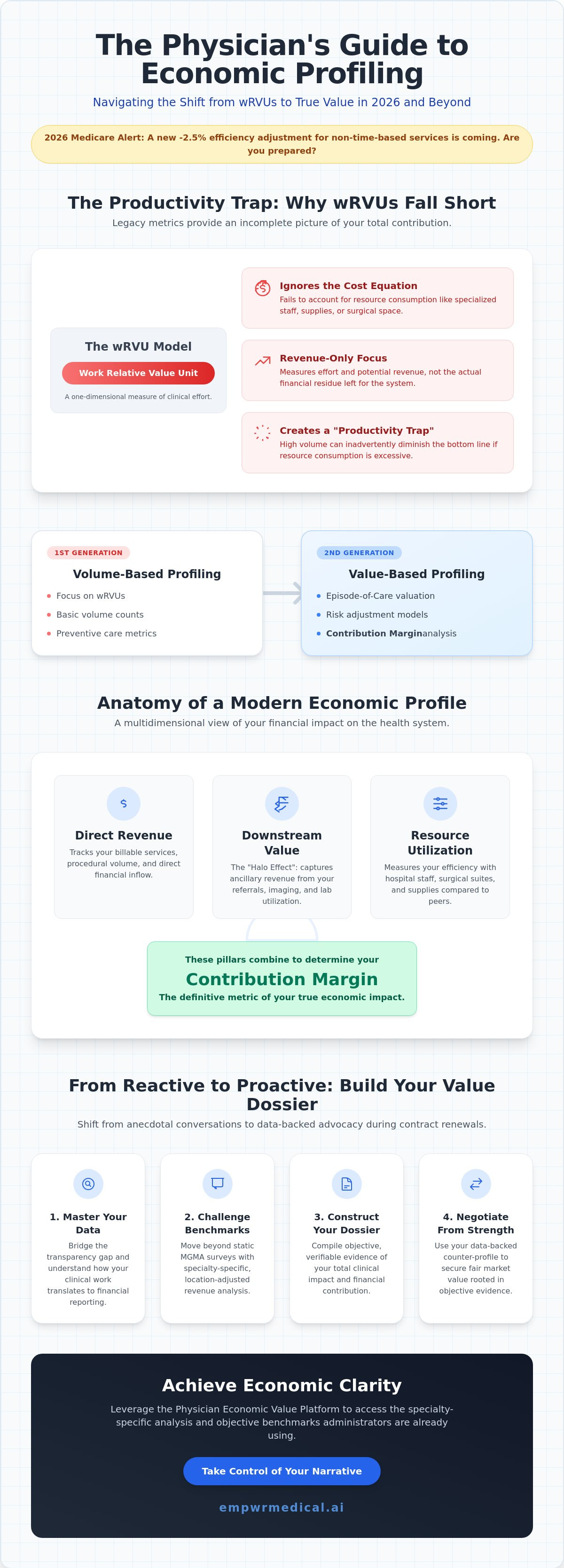
Deciphering the Methodology: How Your Profile is Constructed
Constructing a precise economic profile requires the integration of three distinct data streams. First, hospital accounting systems provide the granular cost of supplies, specialized equipment, and clinical labor. Second, EHR metadata tracks the time-intensity and volume of your clinical encounters. Third, claims data offers a window into the actual reimbursement rates received from both public and private payers. When these inputs are synthesized, they create a physician economic profiling model that reflects your operational reality rather than a simplified productivity estimate.
A critical component of this methodology is risk adjustment. Without this layer of analysis, physicians treating high-acuity populations would appear inefficient simply because their patients require more intensive resources. Sophisticated models now account for patient comorbidities, age, and social determinants of health to ensure a fair comparison. This ensures that a neurosurgeon handling complex trauma isn't penalized for higher resource utilization compared to a colleague performing elective procedures. Systems also apply location-adjusted data to account for regional variances in overhead and labor costs, preventing your value from being diluted by the economic realities of high-cost markets.
Data Sources: Internal vs. External Benchmarks
Internal data focuses on hospital-specific contribution margin reports and billing cycles. While useful, these reports lack the external context needed for strategic planning. High-level analysis requires integrating external benchmarks such as CMS fee schedules and RAND pricing data for physicians to understand how private insurers value your specialty. The Empwr Index Report bridges the gap between these two data worlds, translating your internal operational performance into a comparative score against national and regional market standards.
The Attribution Challenge
Attribution logic determines which physician "owns" the economic outcome of a patient episode. In shared care settings, economic value is frequently misallocated, leading to skewed profiles that don't match clinical reality. For instance, a "Lead Physician" might be credited with the total cost of an episode, while a "Consultant" is only recognized for a single procedural fee. It's vital to verify that your profile reflects your actual clinical workload. The Physician Economic Value Platform allows you to audit these attribution patterns, ensuring you aren't carrying the economic weight of services you didn't direct or control. This clarity is essential for moving from a reactive stance to a proactive, data-backed advocacy position during contract discussions.
The Physician’s Counter-Profile: Using Data for Advocacy
Most clinicians view physician economic profiling as an administrative oversight tool used against them. It's time to invert that dynamic. By constructing a personal "Value Dossier," you transform raw data into a narrative of professional impact. This proactive approach ensures that your clinical contributions are accurately quantified before you enter a physician contract negotiation. You shouldn't wait for a quarterly review to see how the system perceives your worth; you should define it yourself using independent, objective benchmarks.
Auditing hospital-generated reports is the first step in this process. Administrators often rely on automated systems that may misattribute patient episodes or fail to account for the actual costs of specialized care. When you bring your own data to the table, you move the conversation from subjective perception to objective reality. It's about ensuring that every referral, every complex case, and every efficient workflow is visible to the people making financial decisions. To start this process, you can access your Empwr Index Report to see how your performance aligns with market standards.
Steps to Audit Your Own Economic Profile
Begin by requesting your specific contribution margin and payer mix reports from hospital administration. These documents reveal the actual revenue remaining after direct and indirect costs are subtracted. Compare this internal data against transparent national standards to identify discrepancies. Look specifically for "leakage," which occurs when your clinical efforts aren't being captured financially due to coding errors or administrative oversight. For example, if your procedural volume is high but your contribution margin is low, there's likely a mismatch in how your resource utilization is being calculated. Identifying these errors early prevents them from becoming permanent fixtures in your profile.
Leveraging Your Profile in Negotiations
Once you've verified your data, use your physician economic value score to justify base salary increases. This score provides a single, defensible metric that proves your ROI to the health system beyond simple productivity bonuses. Frame the conversation around long-term sustainability. Instead of asking for more money based on "hard work," demonstrate that you are a strategic partner in the system's financial health. When you can show that your episode-based efficiency is in the top decile for your region, you aren't just asking for a raise; you're presenting a data-backed case for fair market value that is difficult for administrators to ignore.
Achieving Economic Clarity with Empwr Medical
Empwr Medical provides the definitive Physician Economic Value Platform designed to return data sovereignty to the clinician. While healthcare systems use internal, often opaque metrics to define your worth, this platform translates complex CMS and RAND data into actionable insights that reflect your actual market value. It serves as a rigorous interpreter between dense institutional accounting and your personal professional strategy. By utilizing specialty-specific revenue analysis, the platform ensures that your economic profile is grounded in the operational realities of your specific field rather than broad, inaccurate generalizations.
The core of this transparency is the Empwr Index. This standardized metric allows you to communicate your value to administrators in a language they already respect and understand. It's a physician-led initiative, meaning the methodology prioritizes clinical nuances that generic financial software often overlooks. This shift from administrative oversight to physician-led physician economic profiling is essential for maintaining professional autonomy in an era of rapid hospital consolidation. It provides the steady assurance of data to back your clinical precision.
The Empwr Index: Your Economic North Star
The Empwr Index provides a location-adjusted, specialty-specific view of your professional worth. It eliminates the guesswork associated with "fair market value" by providing an objective, third-party valuation based on rigorous data modeling. During contract disputes or renewals, having this independent validation is critical. It allows you to move from speculating about your contribution margin to knowing exactly where you stand compared to regional benchmarks. This clarity reduces the cognitive load of negotiations, allowing you to focus on clinical excellence while the data handles the financial justification. The Empwr Index Report acts as a bridge, bringing hidden truths to light for the high-level professional.
Empowering the Next Generation of Physicians
Understanding the mechanics of physician economic profiling is no longer optional for those entering the workforce. Residents and fellows need to grasp these concepts before signing their first employment agreement to avoid the productivity traps of legacy wRVU models. Maintaining an independent economic profile throughout a career provides a long-term strategic advantage. It ensures that your value remains portable and verifiable, regardless of hospital leadership changes or shifts in reimbursement models. To secure your professional future and gain total transparency into your practice, you can Calculate your true economic value with Empwr Medical today.
Securing Your Professional Future with Data-Driven Clarity
The transition from volume-based productivity to episode-based efficiency is not a temporary trend; it's the new operational standard for 2026. Mastering the nuances of physician economic profiling allows you to move beyond the limitations of wRVU metrics and present a comprehensive view of your true contribution margin. By understanding how attribution logic and risk adjustment influence your standing, you gain the leverage needed to negotiate from a position of objective strength rather than subjective perception.
Empwr Medical acts as your rigorous advocate, providing a physician-founded platform that translates authoritative CMS and RAND data into specialty-specific, location-adjusted insights. This methodology ensures your professional worth is quantified with precision and fairness. Whether you're preparing for a contract renewal or seeking transparency in your hospital's financial reporting, having an independent benchmark is essential. Access your personalized Empwr Index Report today to transform complex datasets into an informed conversation about your career. It's time to lead your professional narrative with the steady assurance of clinical and economic clarity.
Frequently Asked Questions
What is the difference between physician profiling and physician credentialing?
Credentialing focuses on your legal and clinical right to practice, while physician economic profiling focuses on your financial efficiency within the system. Credentialing verifies your board certifications, licenses, and clinical competency. Profiling, conversely, analyzes how your practice patterns influence the organization's bottom line through resource utilization and revenue generation. It's the difference between being qualified to operate and being efficient in how you manage the surgical episode.
How does economic profiling affect my Fair Market Value (FMV)?
Economic profiling identifies the specific contribution margin you generate, which serves as a critical defense for a higher Fair Market Value (FMV) assessment. Traditional FMV often relies on broad salary surveys that don't account for your specific efficiency or specialty-specific revenue analysis. By proving that your ROI exceeds regional benchmarks, you provide the objective evidence necessary to justify compensation levels that might otherwise be flagged as exceeding typical productivity standards.
Can I dispute the data used in my hospital’s economic profile?
You have the right to dispute inaccuracies in your profile by auditing the attribution logic and coding data used by administrators. Many hospital reports contain errors related to shared patient care or misallocated supply costs. By presenting an independent counter-profile, you can force a review of the underlying datasets. Correcting these errors ensures that your financial impact is recorded accurately before it influences your next contract cycle.
Does economic profiling take patient satisfaction scores into account?
Economic profiling is strictly a financial metric and generally excludes clinical quality indicators like patient satisfaction scores. While quality profiling measures soft outcomes and patient experience, economic profiling focuses on hard data such as cost per episode and ancillary revenue. It's important to distinguish between these two because a high patient satisfaction score doesn't necessarily correlate with the economic efficiency metrics administrators use for budget planning.
How often should a physician review their economic profile?
You should review your economic profile at least quarterly to ensure that attribution errors are caught and corrected in real time. Waiting for an annual review often means that skewed data has already become the foundation for administrative decisions. Frequent monitoring allows you to track your performance against shifting benchmarks, such as the 2026 Medicare Physician Fee Schedule adjustments, and maintain a decision-ready stance for any strategic professional planning.
What are the risks of ignoring my economic profile during contract renewals?
Ignoring your profile during renewals leaves you vulnerable to one-sided negotiations where the hospital holds all the data. Without a clear understanding of your physician economic profiling data, you can't effectively argue against efficiency penalties or justify base salary increases. This lack of transparency often leads to physicians accepting contracts that undervalue their actual ROI, resulting in significant long-term financial loss and reduced professional autonomy.
How do episode-based profiles handle chronic condition management?
Episode-based profiles manage chronic conditions by utilizing extended measurement windows, often spanning 90 days or a full year, to bundle related costs. Instead of tracking a single encounter, the system aggregates all services associated with that condition's management. This approach identifies whether you're effectively controlling the total cost of care, including pharmacy utilization and specialist referrals, rather than just measuring the volume of office visits you perform.
Is economic profiling the same as Pay-for-Performance (P4P)?
No, economic profiling is the data methodology used to measure value, while Pay-for-Performance (P4P) is the actual reimbursement model. Profiling provides the rigorous analysis that determines if you've met specific benchmarks. P4P is simply the mechanism that triggers a bonus or penalty based on those results. Understanding the profiling methodology is more critical because it dictates the data that eventually determines your P4P outcomes.