

If your hospital's balance sheet only sees you as a generator of relative value units, they're missing the majority of your actual economic contribution. For too long, the industry has relied on narrow productivity metrics that ignore the complex downstream revenue you provide to the healthcare system. Successfully quantifying physician value in 2026 requires a shift from viewing yourself as a labor cost to positioning yourself as a strategic driver of the bottom line.
It's frustrating to enter a contract negotiation knowing your worth exceeds what a standard wRVU report suggests, especially when hospital systems maintain a lack of transparency regarding their ROI calculations. You deserve to walk into those conversations with the same level of data-driven precision that administrators use. In this article, you'll learn how to translate your clinical workload into objective economic impact using authoritative benchmarks and contribution margin analysis. We'll examine the 2026 Medicare conversion factors, including the $33.57 rate for APM participants and the new -2.5% efficiency adjustment, to show you exactly how to build a data-backed report that secures your professional standing.
Key Takeaways
- Move beyond the RVU trap by defining your professional worth through total economic impact rather than simple volume-based productivity metrics.
- Master the rigorous process of quantifying physician value by calculating contribution margins and understanding your specific financial footprint within the hospital system.
- Utilize objective benchmarks, including CMS Fee Schedules and RAND pricing data, to establish a credible and market-adjusted baseline for your revenue generation.
- Implement a structured two-step framework to audit your clinical volume and apply authoritative reimbursement data to your personal CPT frequency reports.
- Shift your negotiation strategy from a standard request for a salary increase toward proposing a fair economic partnership based on transparent, data-backed evidence.
Beyond RVUs: Why Traditional Metrics Fail to Quantify Physician Value
Physician value is often misunderstood as a simple synonym for productivity. In a clinical setting, true value represents the total economic and clinical impact an individual has on a healthcare ecosystem. This includes direct revenue, downstream referrals, and the strategic stability a specialist brings to a facility. However, most employment contracts rely on a narrow set of metrics that fail to capture this breadth. Successfully quantifying physician value requires moving beyond the surface level of production reports to understand the underlying financial mechanics of your practice.
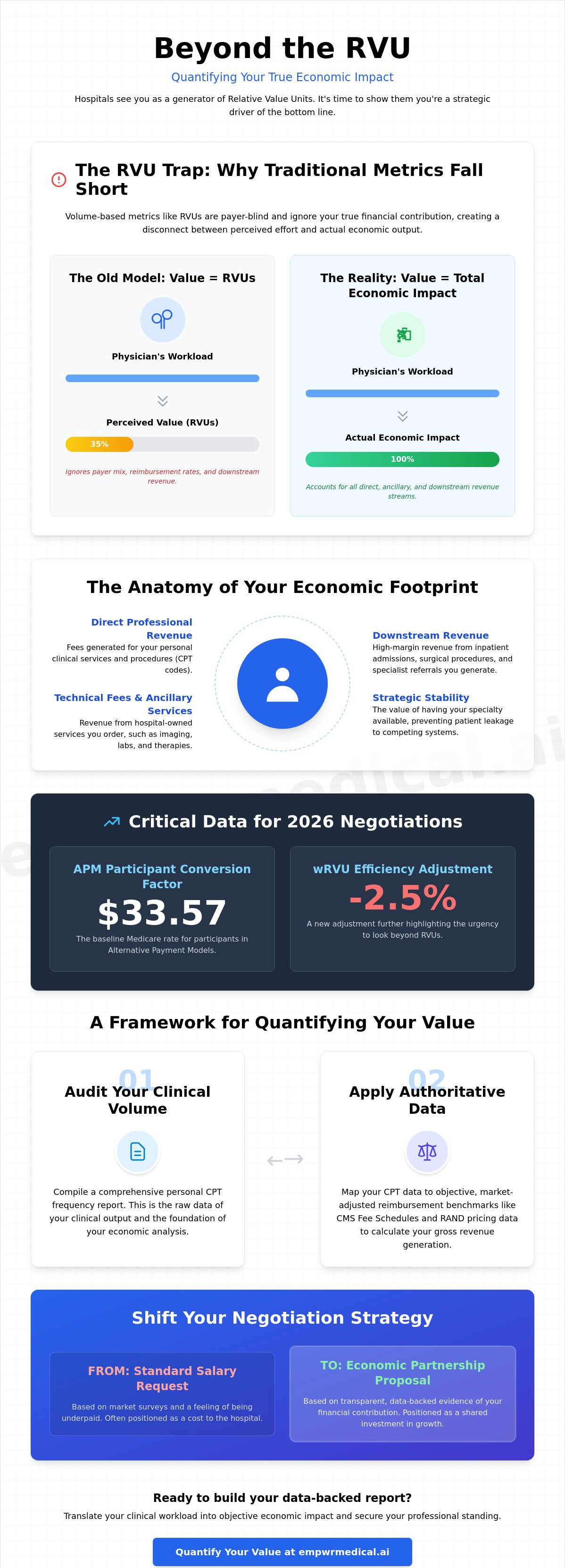
The industry often falls into the "RVU Trap." This occurs when volume-based metrics are treated as the sole proxy for financial contribution. While Relative Value Units (RVUs) provide a standardized way to measure work effort, they ignore the actual revenue generated for the system. A physician might produce high wRVU totals in a service line with low reimbursement rates, leading to a disconnect between perceived effort and actual economic output. In 2026, as Medicare introduces a -2.5% efficiency adjustment to wRVUs, the need for a more sophisticated lens is urgent.
It's important to distinguish between market "worth" and institutional "value." Market worth is essentially a price tag determined by external surveys. It tells you what other people are being paid. Economic value is an internal metric. It measures your strategic significance and financial yield within your specific organization. Relying solely on market worth during negotiations ignores your unique leverage as a revenue driver.
The Limitations of wRVU-Based Compensation
Standard wRVU models are fundamentally payer-blind. They don't account for the nuances of payer mix or geographic reimbursement variances that dictate a hospital's actual cash flow. This creates a significant gap between physician effort and hospital profitability. If you only look at work units, you miss the strategic weight of your specific clinical footprint. Utilizing physician economic profiling allows you to bridge this gap, revealing how your specialty-specific workflows translate into institutional margin.
The Distinction Between Clinical Output and Economic Impact
You must distinguish between clinical output and economic impact. Clinical output is the "what" of your daily routine. It is the sum of surgeries performed, patients seen, and procedures completed. Economic impact is the result. It is the net margin remaining after all direct and indirect costs are accounted for. Hospital administrators prioritize this net margin in their strategic planning, yet they rarely share this granular data with the physicians generating it. Quantifying physician value means uncovering these hidden truths to ensure your compensation reflects your actual economic contribution, not just a market-average benchmark.
The Anatomy of Economic Value: Revenue, Costs, and Contribution Margin
The financial footprint of a physician extends far beyond the professional fees generated at the point of care. To build an accurate model for quantifying physician value, you must account for the full spectrum of revenue streams. This includes direct professional revenue, technical fees from ancillary services like imaging or labs, and the downstream revenue resulting from inpatient admissions and surgical referrals. When these components are viewed in isolation, the physician appears as a mere cost center; when viewed as a system, they emerge as the primary engine of institutional solvency.
By quantifying physician value through this lens, you move the discussion from abstract clinical quality to concrete economic reality. It's no longer about how many patients you saw, but about the net margin you secured for the organization. This shift requires a deep dive into the specific mechanics of revenue and expense allocation that hospitals often keep behind a veil of administrative complexity.
Calculating Gross Revenue from Clinical Workload
Translating clinical effort into financial data begins with mapping Current Procedural Terminology (CPT) codes to specific reimbursement values. This process is complicated by the payer mix, as private insurance contracts often reimburse at significantly higher rates than the 2026 Medicare conversion factor of $33.40 for non-qualifying APM participants. Recognizing the limitations of traditional RVU metrics is essential here, as wRVUs don't reflect these cash flow variances. Gross clinical revenue is the total reimbursement expected for a specific volume of work based on current fee schedules.
Understanding Your Contribution Margin
The contribution margin is the gold standard for determining your economic standing. It's calculated by taking the total revenue you generate and subtracting the variable costs directly attributable to your practice, such as clinical staff salaries, medical supplies, and malpractice premiums. Unlike fixed costs like hospital debt or administrative overhead, variable costs scale with your volume. This metric provides a clearer picture of your profitability than simple salary benchmarks because it shows exactly how much you contribute to the hospital's ability to cover its fixed expenses. If you want to see how your specific specialty compares, a specialty-specific revenue analysis can provide the necessary granularity.
In a negotiation, the contribution margin is your strongest lever. While administrators might argue that your salary is high compared to national averages, they can't easily dismiss a report that shows you're generating a healthy net margin after all direct expenses. This approach shifts the conversation from your "price" to your "performance." It transforms you from a line item into a strategic partner whose presence is vital for the system's financial health.
Utilizing Authoritative Data for Objective Valuation
Objective evidence is the only currency that matters in a high-stakes negotiation. While previous sections established the importance of the contribution margin, successfully quantifying physician value depends entirely on the quality of the data inputs you use. Relying on vague hospital reports or outdated national averages leaves you vulnerable to administrative pushback. To build a defensible case, you must ground your analysis in authoritative, third-party benchmarks that reflect the current 2026 reimbursement landscape.
A rigorous valuation requires a multi-layered approach. It starts with the public floor of CMS fee schedules and moves into the nuanced realm of private payer premiums. By layering these sources, you create a transparent model that administrators find difficult to refute. This transparency is the bridge between feeling undervalued and proving your economic necessity.
The Role of CMS and RAND Benchmarks
The Centers for Medicare & Medicaid Services (CMS) Fee Schedule serves as the baseline for any objective valuation. It provides a standardized, public floor for reimbursement rates across every CPT code. While the American Medical Association provides clear guidance on how RVUs measure physician productivity, these units don't translate into actual dollars without a specific multiplier. In 2026, with the Medicare conversion factor set at $33.57 for qualifying APM participants, this data provides the starting point for your revenue calculations.
However, CMS data only tells half the story. RAND pricing data is essential for understanding the "commercial premium" that private insurers pay above Medicare rates. Hospitals often capture this premium without reflecting it in physician compensation. Integrating physician fair market value data that combines CMS baselines with RAND benchmarks ensures your valuation reflects the total revenue you generate, not just the lowest common denominator.
Adjusting for Specialty and Geographic Nuance
Data loses its power when it's too broad. A cardiologist in Manhattan operates in a vastly different economic reality than one in rural Nebraska. Geographic adjustments are non-negotiable because they account for local cost-of-living variances and regional payer behavior. Without these adjustments, your data is easily dismissed as irrelevant to your specific market.
Specialty-specific workflows also dictate how value is captured. For instance:
- Procedural Specialties: Value is often concentrated in high-margin technical fees and surgical facility charges.
- Cognitive Specialties: Value is frequently found in downstream management, chronic care coordination, and pharmacy spend reduction.
Broad national surveys often lack the granularity to distinguish between these models. When quantifying physician value, you must use data that respects these specialty-specific nuances. This level of detail transforms a generic request for a raise into a sophisticated proposal for a fair economic partnership.
A Framework for Quantifying Your Personal Value Proposition
Moving from conceptual understanding to actionable reporting requires a structured workflow. Successfully quantifying physician value isn't an exercise in estimation; it's a sequence of logical steps that translate clinical activity into economic output. By following this framework, you can build a report that stands up to administrative scrutiny and provides a clear picture of your contribution to the system's financial health.
- Step 1: Audit clinical volume. Request your CPT frequency reports for the last 12 to 24 months. These reports provide the raw data necessary to understand the complexity and volume of the services you provide.
- Step 2: Apply authoritative reimbursement benchmarks. Use the CMS and RAND data discussed previously to assign a dollar value to your clinical activity. This determines your gross clinical revenue floor.
- Step 3: Factor in downstream economic impact. Calculate the revenue generated by ancillary services you order, such as imaging, labs, and physical therapy, as well as inpatient admissions and surgical referrals.
- Step 4: Subtract direct variable costs. Remove the expenses that only exist because you are practicing, such as your clinical support staff and medical supplies. This reveals your contribution margin.
- Step 5: Compare against regional FMV benchmarks. Place your contribution margin in the context of regional fair market value (FMV) to see where you sit relative to the market.
Gathering Your Internal Data
The foundation of your analysis is the data residing in your practice management system. You should specifically request a CPT frequency report and a payer mix report. It's vital to distinguish between "encounters" and "procedures." While encounters measure your schedule's density, procedures dictate your economic yield. Additionally, track your "leakage," which refers to patients you refer to specialists outside your hospital system. Demonstrating the potential revenue lost to leakage can be a powerful strategic lever during negotiations.
Benchmarking Against National Standards
Once you have your internal numbers, you must validate them against external standards to ensure they are defensible. This is where the Empwr Index Report provides clarity, acting as a simplified benchmark for your economic standing. To gain a deeper understanding of how administrators view these numbers, review our guide on physician financial impact analysis for hospitals. If you're ready to see your specific numbers in a structured format, our Physician Economic Value Platform can automate this analysis for you.
Strategic Advocacy: Leveraging Value for Contract Negotiations
Data is only as effective as the conversation it facilitates. After completing the rigorous process of quantifying physician value, you must transition from the spreadsheet to the boardroom. Presenting these findings requires a shift in mindset. You aren't merely asking for a salary increase based on market averages; you're proposing a fair economic partnership grounded in the objective reality of your contribution margin. This approach replaces emotional appeals with professional clarity, making it difficult for administrators to dismiss your position.
A significant advantage of this data-driven strategy is the ability to justify necessary clinical resources. While some argue that tracking productivity leads to burnout, the opposite is true when you use that data to prove your need for more support. If your contribution margin is high, you have the economic leverage to request additional medical assistants or scribes. These resources don't just reduce your administrative burden; they protect the hospital's most valuable revenue-generating asset: your time.
From Data to Dialogue: Preparing for Negotiation
When you sit down with an administrator, start by acknowledging the system's financial objectives. You might say: "I've performed a detailed analysis of my practice's contribution margin using authoritative 2026 benchmarks. I'd like to discuss how we can align my compensation with the actual economic value I'm delivering to the system." This opening establishes you as a sophisticated professional who understands the business of medicine.
Expect objections regarding "hospital overhead" or "unallocated system costs." Administrators often use these broad categories to dilute individual profitability. Respond by focusing on the variable costs you've already accounted for in your contribution margin analysis. Remind them that your role is to drive the revenue that covers those fixed overhead costs. You should frame your value as a shared interest in the health system’s financial sustainability.
The Empwr Index: Your Data-Backed Advantage
The Empwr Index simplifies the task of quantifying physician value by automating the integration of specialty-specific revenue analysis with current CMS and RAND benchmarks. Manually calculating these metrics every year is a significant undertaking that most busy clinicians can't sustain. Having an annual valuation ensures you're never caught off guard by shifts in the 2026 Medicare conversion factor or changes in regional payer behavior. It provides a steady baseline for informed conversations, allowing you to focus on clinical excellence while your economic standing remains transparent and secure. Quantify your value today with the Empwr Index Report.
Securing Your Economic Standing with Data-Driven Clarity
The shift from narrow productivity metrics to a comprehensive economic model is the most critical step you can take for your career in 2026. You've learned that your contribution margin and downstream impact are the true measures of your worth within a hospital system. By quantifying physician value with precision, you transform contract discussions from a request for a raise into a professional dialogue about strategic partnership.
Our platform was built by physicians for physicians who value objective evidence over administrative ambiguity. We utilize authoritative CMS and RAND data sources to deliver specialty-specific and location-adjusted reporting that reflects the reality of your practice. This level of granularity ensures that your data is defensible, transparent, and ready for the boardroom. It's about moving beyond the RVU trap to ensure your compensation reflects the actual revenue you generate for the system.
Take control of your professional narrative by securing the insights you deserve. Access Your Empwr Index Report and Quantify Your Value to begin your journey toward economic clarity. You've mastered the clinical complexities of your field; now it's time to master the data that defines your professional future.
Frequently Asked Questions
What is the difference between physician worth and physician value?
Physician worth is an external market benchmark that reflects the average compensation for your specialty across a region or country. In contrast, physician value is an internal measure of your specific economic contribution to your organization. While worth tells you what your peers earn, value quantifies your strategic significance and financial yield within your unique clinical ecosystem.
How do I calculate my contribution margin as a physician?
You calculate your contribution margin by subtracting direct variable costs from the total revenue you generate. Direct variable costs include expenses specifically tied to your practice, such as clinical support staff and medical supplies. This metric is essential for quantifying physician value because it reveals the net margin available to cover the hospital's fixed overhead and institutional debt.
Why is wRVU a poor metric for quantifying my true value?
The wRVU is a poor metric because it only measures work effort and ignores the actual reimbursement received by the hospital. It's payer-blind, meaning it doesn't account for the higher premiums paid by private insurers versus the $33.40 Medicare rate for non-qualifying APM participants. Relying on wRVUs creates a disconnect between your clinical labor and the actual financial health of the healthcare system.
Where can I find authoritative physician fair market value data in 2026?
Authoritative fair market value data in 2026 is found by integrating the CMS Fee Schedule with RAND commercial pricing benchmarks. CMS provides the standardized floor for reimbursement, while RAND data reveals the commercial premiums paid by private insurers. Accessing reports that synthesize these sources allows you to establish a defensible and location-adjusted baseline for your professional standing.
Can I quantify my value if I am in a non-procedural specialty?
You can absolutely quantify your value in a non-procedural specialty by focusing on downstream management and chronic care coordination. For cognitive specialties, economic impact is often found in pharmacy spend reduction, reduced readmission rates, and the referrals generated for diagnostic testing. These metrics demonstrate a strategic value that extends far beyond simple encounter volume.
How does geographic location affect my economic value score?
Geographic location affects your economic score by adjusting reimbursement rates to reflect local market realities and cost-of-living variances. Payer behavior and Medicare GPCI adjustments mean that the same clinical volume generates different revenue in different regions. Accurate quantifying physician value requires data that is specifically tuned to your local zip code to remain credible during negotiations.
What data sources are most reliable for physician revenue estimates?
The most reliable sources for revenue estimates are your internal CPT frequency reports paired with external benchmarks from CMS and RAND. Your internal reports provide the "what" of your practice, while external fee schedules provide the "how much." Combining these creates a transparent and objective model for estimating the gross revenue your clinical activity produces.
Should I share my contribution margin analysis with my employer during negotiations?
You should share your contribution margin analysis during negotiations to shift the dialogue from a request for a raise to a discussion about a fair partnership. Presenting objective data demonstrates your understanding of the hospital's financial goals. It positions you as a transparent professional who is committed to the system's sustainability while ensuring your compensation is rooted in documented economic impact.