

Relying on the industry's most popular salary surveys might actually be the primary obstacle to securing your true market value. While these aggregate benchmarks provide a standardized baseline, they often rely on lagging data that fails to account for the specific revenue you generate within your unique clinical workflow. You've likely experienced the frustration of being measured against broad percentiles that ignore your actual economic contribution to the health system. This disconnect is driving a shift toward advanced software for physician contract negotiation, tools designed to replace generalities with precise, location-adjusted data.
We understand that you value objective evidence over emotional appeals when discussing your professional future. This article demonstrates how modern economic valuation software empowers you to move beyond static benchmarks and negotiate based on your documented revenue impact. We'll explore the mechanics of specialty-specific revenue analysis and how it provides the clarity needed to confirm your compensation aligns with 2026 Fair Market Value standards. You'll learn how to translate complex procedural data into professional reports that position you as a high-level partner in every financial conversation.
Key Takeaways
- Understand why traditional salary surveys often provide lagging data and how real-time valuation tools offer a more accurate representation of your current market standing.
- Explore how modern software for physician contract negotiation utilizes CMS fee schedules and RAND pricing data to quantify your exact revenue impact.
- Learn the importance of contribution margin analysis and specialty-specific revenue modeling in defining your true economic value to a health system.
- Discover how to transition your negotiation strategy from subjective requests to data-driven arguments using professional, software-generated reports.
- Gain insight into the Empwr Index, a methodology that translates complex clinical workflows into a single, authoritative score for informed contract discussions.
The Evolution of Software for Physician Contract Negotiation
The landscape of physician compensation has fundamentally shifted. For decades, doctors relied on static PDF reports and word-of-mouth anecdotes to gauge their worth. Today, the emergence of specialized software for physician contract negotiation has replaced these outdated methods with dynamic valuation platforms. This evolution reflects a broader demand for clinical revenue transparency within the healthcare industry. Physicians are no longer content with being passive recipients of compensation data; they're becoming active participants in economic modeling.
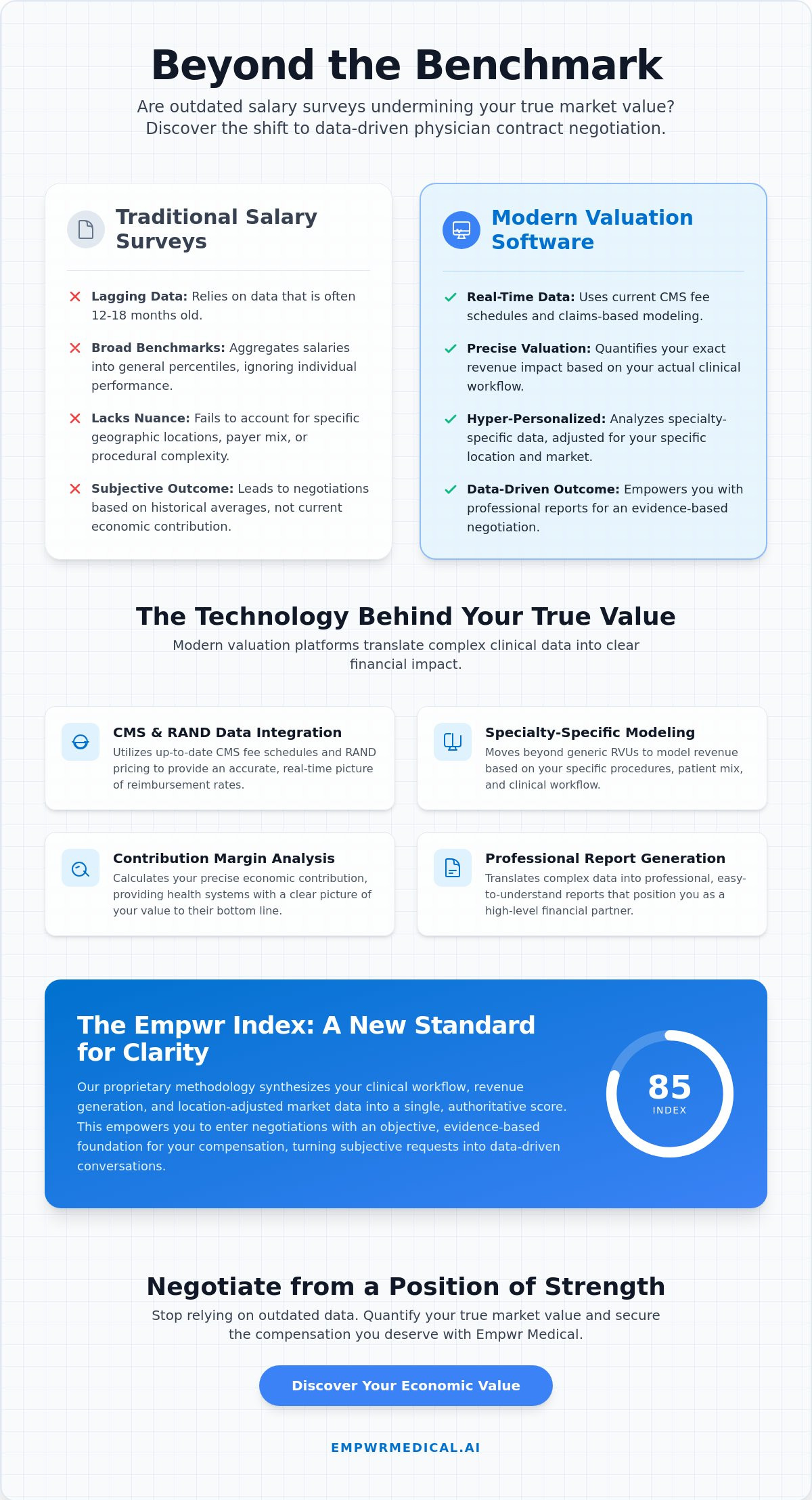
Traditional benchmarks like MGMA often lag behind current market realities because they rely on self-reported data from previous fiscal years. By the time a survey is published, the economic data is often 12 to 18 months old. In a volatile economy where overhead costs and payer rates fluctuate rapidly, relying on historical averages is a strategic risk. Modern economic value software addresses this by providing a tool for real-time clarity. It allows clinicians to advocate for themselves using the same sophisticated data sets that hospital administrators use during budget planning.
Why Static Benchmarks are Failing Physicians in 2026
In the current environment, a 12 to 18 month lag in data reporting can result in significant compensation gaps. Static surveys aggregate data into broad percentiles, which frequently masks critical geographic nuances and specialty-specific shifts. For instance, an 'average' salary in a high-cost urban center doesn't reflect the true cost of living or the specific local reimbursement landscape. Additionally, these surveys struggle to account for the impact of rising overhead. As hospitals transition toward value-based purchasing models, the traditional focus on RVUs alone fails to capture the comprehensive economic impact a physician has on a health system's bottom line. Relying on an outdated PDF means you're negotiating for your future using data from the past.
Defining the Modern Negotiation Tech Stack
It's vital to distinguish between the tools used by hospitals and those designed for physicians. Most health systems utilize enterprise-level Contract Lifecycle Management (CLM) software to manage thousands of vendor and employment agreements. In contrast, a true Physician Economic Value Platform is a physician-focused tool designed for advocacy. These platforms bridge the information gap between clinicians and CFOs by translating clinical volume into financial language. By utilizing Specialty-Specific Revenue Analysis, physicians can move beyond "fair market value" as a defensive ceiling and instead present it as an evidence-based floor for their compensation. This technology ensures that the negotiation is based on objective contribution rather than institutional tradition.
Comparing Traditional Databases vs. Real-Time Valuation Tools
Physicians often begin their search for Physician compensation data by consulting national averages. While these figures offer a broad baseline, they lack the granular detail required for a high-stakes negotiation. The fundamental difference between traditional databases and modern valuation tools lies in their methodology. Traditional reports rely on survey-based data, which is essentially a retrospective look at what other physicians reported earning in the past. In contrast, modern software for physician contract negotiation utilizes claims-based modeling to determine what you are worth today based on current reimbursement rates and clinical volume.
Real-time data is especially vital for a physician contract renewal negotiation. When you're renegotiating an existing agreement, your employer already has access to your production data. If you show up with a lagging survey from 2024, you're at a distinct disadvantage. You need a tool that accounts for location-adjusted nuances, such as regional cost-of-living shifts and specific payer mix variations. This level of precision transforms the negotiation from a request for a "market raise" into a professional discussion about revenue sharing and economic contribution.
The Limitations of Survey-Based Compensation Data
Survey-based data suffers from inherent structural flaws that can undermine your negotiating position. Because participation is voluntary, these reports often reflect a self-reporting bias that may not represent the entire market. In niche specialties or rural health systems, the sample sizes are frequently too small to be statistically significant. Perhaps most importantly, these surveys don't correlate reported salaries with the actual profitability of the hospital. They show you what your peers are paid, but they never explain why that number was reached or how much revenue those peers generated to justify it.
The Power of Claims-Based Economic Modeling
Claims-based modeling offers a more rigorous alternative by leveraging authoritative data from the Centers for Medicare & Medicaid Services (CMS) and the RAND Corporation. This approach translates your specific CPT codes and clinical volume into gross revenue estimates. It removes the guesswork by using the 2026 Medicare Physician Fee Schedules and Geographic Practice Cost Indices (GPCI). By focusing on objective inputs, you can ensure your valuation meets strict Fair Market Value (FMV) standards. Generating a Specialty-Specific Revenue Analysis allows you to see the exact dollar value your clinical work brings to the institution, providing the quiet confidence needed to advocate for your worth.
- Accuracy: Uses actual 2026 reimbursement rates rather than 18-month-old surveys.
- Transparency: Reveals the "hidden" revenue generated by your clinical activity.
- Objectivity: Provides a third-party, data-driven report that is difficult for administrators to dismiss.
Core Features of Effective Physician Valuation Software
Effective software for physician contract negotiation must do more than display static percentiles. It needs to act as a bridge between clinical output and financial outcomes. This requires a suite of analytical tools that translate CPT codes and volume into a clear economic picture. By moving beyond the surface-level metrics of wRVUs, these platforms allow you to see the same financial realities that hospital executives see. This visibility is the foundation of a fair and transparent negotiation process.
Modern platforms prioritize decision-ready data. Instead of forcing you to manually calculate your impact, the software should automate the heavy lifting of financial modeling. This ensures that the data you bring to the table is rigorous, objective, and difficult to dismiss. It transforms the negotiation from a debate over "fairness" into a professional discussion about documented economic contribution.
Contribution Margin and Revenue Potential
Many physicians mistakenly focus on gross billings or wRVUs as the primary measure of their worth. However, administrators are far more concerned with your contribution margin. Contribution margin is the revenue remaining after direct variable costs. Understanding this figure allows you to calculate the net economic impact of your specific clinical practice. It reveals exactly how much profit your work generates for the system after accounting for direct expenses like your salary, benefits, and clinical supplies. By quantifying this net impact, you can advocate for compensation that reflects your true value to the organization's bottom line.
Specialty-Specific and Geographic Nuance
A generalist revenue model differs fundamentally from a complex surgical workflow. Utilizing a specialty specific revenue analysis ensures that your negotiation floor is based on your specific clinical reality. These tools account for the nuances of different practice environments, whether you're in an academic center, a private group, or a large health system. Geographic pay differentials also play a critical role in local market competitiveness. Effective software adjusts for these regional variations, ensuring that your compensation reflects both your specialty's demands and your location's economic standards.
- Dynamic Dashboards: These allow for "what-if" scenario planning, letting you model how changes in patient mix or call schedules affect your economic value.
- Automated Reporting: The software generates professional, decision-ready documents that translate complex data into clear insights for administrators.
- Facility-Type Adjustments: Ensures the data is relevant to your specific employer's business model and overhead structure.
The goal of these features is to provide quiet confidence. When you understand the mechanics of your own economic impact, you don't need to rely on emotional appeals. You simply present the data and let the methodology speak for itself.
How to Use Software Insights in Your Negotiation Strategy
Data is only as powerful as your ability to present it. While having access to sophisticated software for physician contract negotiation provides the necessary clarity, the final step involves translating those insights into a compelling business case. Administrators respond to objective evidence that aligns with the organization's fiscal health. By shifting the dialogue from personal desire to economic reality, you position yourself as a high-level professional who understands the business of medicine. This strategic shift moves the conversation from "I want" to "the data shows," which is a much harder position for an employer to dismiss.
For those early in their careers, this approach is transformative. Effective physician contract negotiation for residents often hinges on demonstrating potential value in the absence of a long historical track record. Using software-generated projections allows residents to show how their specific training and anticipated volume will contribute to the hospital's success from day one. It replaces the vulnerability of being a new hire with the authority of a data-driven partner who understands their worth.
Beyond the 'Average' Compensation Argument
Hospitals often use the 50th percentile of a salary survey as a default ceiling for compensation. However, if your productivity or revenue generation sits in the 75th or 90th percentile, accepting an average salary creates a significant value gap. Software insights allow you to highlight untapped revenue potential, such as downstream referrals or technical fees that your clinical work captures. You can also connect clinical quality metrics to economic value, showing how high-quality outcomes reduce long-term costs for the system. This evidence justifies a move toward higher compensation tiers based on actual performance rather than arbitrary benchmarks.
Visualizing Your Economic Impact
Non-clinical executives, such as CFOs and COOs, process information through the lens of financial dashboards and professional reports. When you present a Physician Value Proposition document, you provide them with a decision-ready summary of your impact. This document should visualize your revenue generation, contribution margin, and market standing in a format they recognize. Beyond base salary, this data serves as leverage to secure non-salary terms. If the hospital is firm on a salary cap, use your revenue data to negotiate for increased CME allowances, retention bonuses, or specialized equipment that enhances your clinical efficiency.
To begin building your data-driven case, you can request an Empwr Index Report to see your true economic standing today.
Empwr Medical: The New Standard for Physician Economic Clarity
Empwr Medical operates as a dedicated Physician Economic Value Platform, providing the necessary bridge between clinical expertise and financial reality. Unlike enterprise-level systems designed for hospital administration, this platform is built with a physician-led design that prioritizes the individual clinician's advocacy. It addresses the "black box" of hospital revenue models by offering a transparent methodology for calculating professional worth. This specialized software for physician contract negotiation ensures that you aren't just reacting to an offer, but leading a strategic discussion based on your actual economic footprint.
The methodology relies on the steady assurance of data rather than the variability of self-reported surveys. By utilizing licensed access to 2026 CMS and RAND data sources, the platform provides a rigorous foundation for every valuation. This transition toward data-backed transparency allows you to approach physician contract negotiation with quiet confidence. You no longer need to wonder if your compensation reflects the current market; you'll have the evidence to prove it does.
The Empwr Index and Revenue Analytics
The core of our methodology is the Empwr Index, which translates your specific clinical workload into clear revenue estimates. This index accounts for the nuances of your CPT coding patterns, patient volume, and the technical fees generated by your clinical activity. By pulling from the most recent 2026 Medicare Physician Fee Schedules and Geographic Practice Cost Indices, the system ensures your data is never lagging or irrelevant. The Empwr Index score simplifies complex financial data into a single negotiation lever. This single score acts as an authoritative benchmark, allowing you to quickly communicate your professional standing to non-clinical executives during high-stakes meetings.
Empowering Informed Conversations
Data is a means to an end, specifically the ability to conduct better communication and strategic planning. When you understand your contribution margin and specialty-specific revenue impact, your posture shifts from defensive to strategic. You're no longer asking for a raise based on what you hope is fair; you're confirming that your compensation reflects verified Fair Market Value standards. This level of clarity provides a sense of fairness and transparency that is often missing from the employment relationship. It fosters a professional partnership where both the physician and the health system operate from a shared set of objective facts.
- Rigorous Methodology: Based on established CMS and RAND standards for 2026.
- Decision-Ready Reports: Designed to reduce cognitive load for both you and the administrator.
- Personal Advocacy: A tool that translates your clinical precision into financial language.
Securing your professional future requires more than just clinical excellence; it requires economic clarity. You can calculate your true economic value with Empwr Medical and enter your next negotiation with the steady assurance of data-driven insights.
Securing Your Professional Value Through Economic Clarity
The transition from retrospective salary surveys to real-time economic modeling represents a fundamental shift in physician advocacy. By moving beyond aggregate percentiles and utilizing software for physician contract negotiation, you gain the ability to quantify your true revenue impact with clinical precision. This data-driven approach replaces subjective requests with objective evidence, ensuring that your compensation reflects the actual contribution you bring to your health system. You now have the tools to bridge the information gap between the clinic and the executive suite.
Empwr Medical provides the steady assurance of methodology over marketing. Our Physician Economic Value Platform utilizes authoritative CMS and RAND pricing data to generate the proprietary Empwr Index score, a single authoritative metric for your impact. As a physician-founded and specialty-specific solution, we're dedicated to bringing hidden truths to light through rigorous analysis. It's time to replace uncertainty with the quiet confidence of data-backed transparency.
Start Your Data-Driven Negotiation with Empwr Medical and ensure your next contract reflects your true market value.
Frequently Asked Questions
What is the best software for physician contract negotiation in 2026?
Empwr Medical's Physician Economic Value Platform is the leading standard because it moves beyond static surveys to provide real-time economic modeling. It utilizes current CMS and RAND data to quantify your specific revenue impact rather than relying on lagging industry averages. This level of precision is essential for clinicians who want their compensation to reflect their actual production rather than a broad percentile.
Is physician negotiation software worth the cost for residents?
Yes, utilizing valuation software is highly beneficial for residents because it establishes an evidence-based baseline for their first professional contract. Since residents lack a historical production record, software-generated projections allow them to demonstrate their anticipated economic contribution. This data-driven approach removes the guesswork from initial offers and ensures that new physicians aren't undervalued as they enter the workforce.
How does negotiation software differ from a standard salary survey?
Standard salary surveys are retrospective reports of what others were paid, while software for physician contract negotiation is a prospective tool that calculates what you generate. Surveys often lag by 12 to 18 months and rely on voluntary, self-reported data. In contrast, valuation software uses current reimbursement schedules and claims-based modeling to provide a real-time estimate of your specific economic value to a health system.
Can I use software to calculate my contribution margin as a physician?
You can certainly use specialized valuation platforms to determine your contribution margin by analyzing your clinical volume against direct variable costs. This metric is critical because it represents the actual profit your work generates for the hospital after accounting for expenses. Understanding this figure allows you to negotiate from a position of clarity, showing administrators exactly how much revenue remains to support the organization's mission.
Does physician contract software include legal review?
Physician valuation software typically focuses on economic modeling and revenue analysis rather than providing legal representation. While these tools generate the data and reports needed for a successful negotiation, they don't replace the need for a qualified healthcare attorney to review the legal language of your agreement. The software provides the financial "what," while a legal professional ensures the contractual "how" is sound.
How do I present software data to my hospital administrator without being confrontational?
Presenting software data should be framed as a collaborative effort to ensure transparency and fairness within the professional partnership. By bringing a professional report to the table, you shift the conversation from an emotional request to an objective, data-driven discussion. This approach signals that you understand the hospital's financial operational realities, which often fosters a more productive and less adversarial negotiation environment.
What data sources should I look for in a physician valuation tool?
An effective valuation tool must utilize authoritative, third-party sources such as the 2026 Medicare Physician Fee Schedules and RAND pricing data. You should look for platforms that integrate Geographic Practice Cost Indices (GPCI) to ensure your data is location-adjusted and specialty-specific. Relying on these verified government and research benchmarks ensures that your valuation meets strict Fair Market Value standards and is defensible during administrative review.
Can software help with physician contract renewal negotiations?
Software is particularly effective for renewals because it allows you to input your actual production data from the previous contract term to justify a compensation adjustment. It helps you identify if your current pay has fallen behind the revenue you're generating or if market reimbursement rates have shifted. Using software for physician contract negotiation during a renewal ensures your new agreement reflects your current clinical impact rather than your initial hiring terms.