

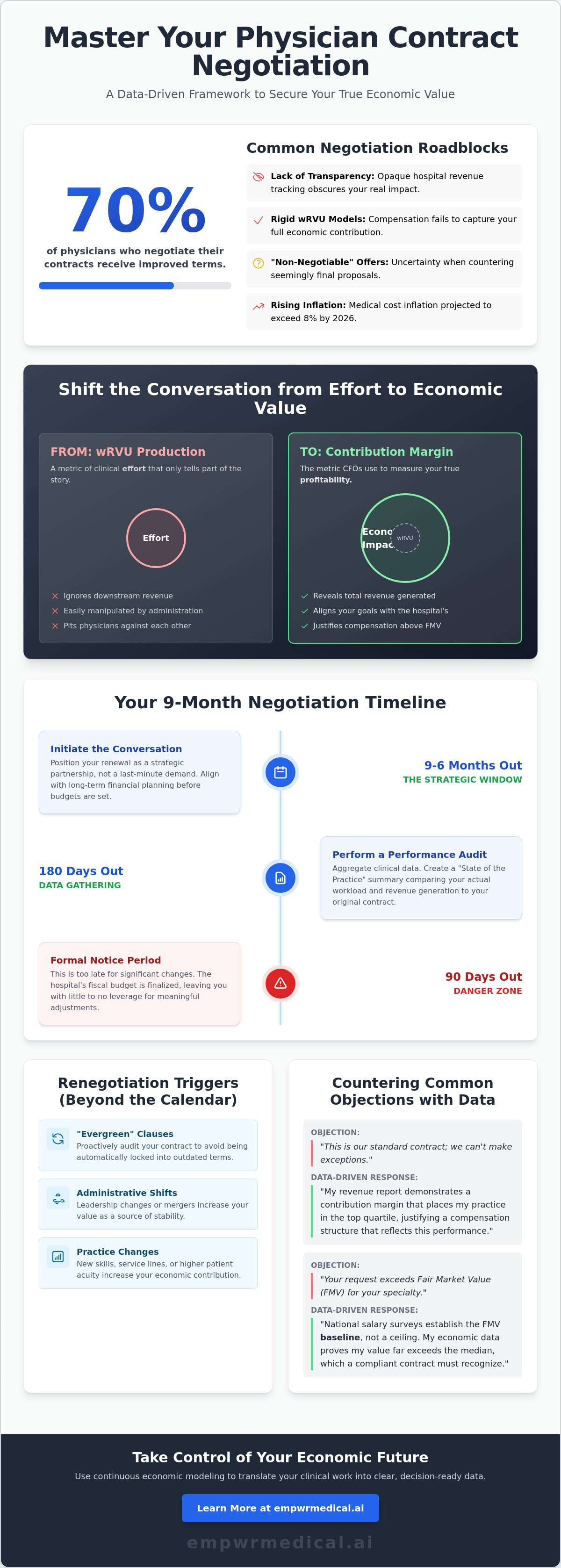
Did you know that over 70% of physicians who actively negotiate their contracts receive improved terms? Despite this potential for gain, many practitioners approach their physician contract renewal negotiation feeling disadvantaged by a lack of transparency in hospital revenue tracking. You might feel trapped by rigid wRVU-only compensation models that fail to capture your full economic impact on the health system. It's common to feel uncertain when countering offers presented as non-negotiable, especially when medical cost inflation is projected to exceed 8% heading into 2026.
We believe your contract renewal should be an economic conversation based on clarity, not just a legal formality. You'll learn how to leverage clinical revenue data and contribution margins to secure a fair agreement that reflects your true professional value. This guide provides a strategic framework to move beyond standard salary surveys. We will examine how to use objective data to advocate for better compensation, improved administrative support, and a package that recognizes the actual revenue you generate for your organization.
Key Takeaways
- Learn why initiating your physician contract renewal negotiation six to nine months in advance is critical for establishing leverage and aligning with institutional budget cycles.
- Discover how to shift the conversation from wRVU production to contribution margin to reveal the full economic value you bring to the health system.
- Master a structured framework for aggregating clinical data and translating your productivity into a decision-ready revenue report.
- Gain strategies to dismantle the "standard contract" myth and redefine Fair Market Value as a baseline rather than a compensation ceiling.
- Understand how continuous economic modeling through the Empwr Index provides the clarity needed for long-term career planning and sustainable professional growth.
Timing and Triggers for Physician Contract Renewal Negotiation
Timing is the most undervalued asset in any physician contract renewal negotiation. Most clinicians wait until the hospital sends a formal notice, typically 90 days before expiration. By that point, the administration has already finalized the upcoming fiscal budget. This leaves you with very little room for meaningful adjustments to your base pay or incentive structures. Starting the process six to nine months early allows you to position your request as a strategic partnership rather than a last-minute demand. It gives the organization time to account for your value in their long-term financial planning.
You must also stay vigilant regarding "Evergreen" clauses. These provisions automatically renew your contract under existing terms unless you provide written notice within a specific window. If you miss this date, you might be locked into outdated compensation models for another two or three years. Hospitals often rely on this professional inertia to maintain lower overhead. Breaking this cycle requires a proactive audit of your clinical and economic contributions long before the legal deadline. Don't let a calendar oversight dictate your financial future.
Administrative shifts often provide unexpected leverage. When a department head leaves or a hospital undergoes a merger, the stability you provide becomes a premium asset. Leadership is frequently willing to offer better terms to retain key clinical staff during times of institutional transition. These moments of change are prime opportunities for a physician contract renewal negotiation because the cost of replacing you during a period of instability is significantly higher than meeting your fair market value requirements.
The 180-Day Strategy
Six months before your notice period, you should perform a comprehensive audit of your performance metrics. This is the time to identify discrepancies between your actual daily workload and the initial assumptions made in your original agreement. Perhaps you're handling higher acuity patients or managing more administrative burdens than anticipated. Preparing a "State of the Practice" summary at this stage gives you the objective evidence needed to initiate the conversation from a position of strength. It transforms the negotiation from an emotional plea into a data-driven business proposal that's difficult for administrators to dismiss.
Non-Date Triggers for Renegotiation
Your contract isn't just a calendar-based document; it's a reflection of your current clinical reality. Significant changes in your department, such as a shift in call frequency or the launch of a new service line, create immediate opportunities to discuss compensation adjustments. If you've mastered high-revenue technology or obtained new certifications, your economic value to the organization has increased. It's also vital to track external economic factors. With medical cost inflation projected to exceed 8% heading into 2026, staying informed on current physician fair market value data is essential. Understanding the historical context of physician employment agreements helps you see that these documents are meant to be dynamic. When market rates or your specific clinical contributions change, the contract must evolve to remain equitable.
Moving Beyond wRVUs: The Contribution Margin Advantage
Standard productivity metrics often fail to capture the full scope of your financial contribution. While most health systems rely on Work Relative Value Units (wRVUs) as the primary lever for compensation, this metric only quantifies your clinical effort. It ignores the actual revenue captured by the organization. For a successful physician contract renewal negotiation, you must shift the focus toward your contribution margin. This financial metric represents the total revenue you generate minus the direct variable costs associated with your practice. From a CFO's perspective, this is the most accurate way to determine if a physician is a profit center or a financial liability.
Administrators view your practice through a lens of operational efficiency. When you demonstrate that your contribution margin far exceeds the costs of your salary and benefits, you eliminate the "Fair Market Value" ceiling they often try to impose. A comprehensive guide to physician contract renegotiation should emphasize that your leverage isn't just your work ethic; it's the specific dollar amount you add to the hospital's treasury. By translating clinical volume into health system revenue, you speak the language of administration and prove your economic necessity. This data-driven approach is the only way to counter claims that an offer is non-negotiable.
wRVU vs. Contribution Margin
wRVUs measure how hard you work, but contribution margin measures how much you earn for the system. High-revenue procedures in specialties like cardiology or radiology are often undervalued in pure wRVU models because the reimbursement rates don't always align with the "work" units assigned. You can find more detail on these mechanics in our guide to physician relative value units explained. Understanding this gap allows you to argue for a "total rewards" package that reflects your actual economic impact rather than an arbitrary productivity score.
Calculating Your Economic Footprint
Calculating your economic footprint requires looking at the 2026 Medicare Physician Fee Schedule, which finalized a 3.26% increase for most rates. You also need to account for geographic adjustments and RAND pricing data that generic surveys often overlook. The Empwr Index serves as a critical benchmark here, providing a location-adjusted view of your specific clinical impact. For those seeking deeper insights, a Specialty-Specific Revenue Analysis can pinpoint exactly where your practice is generating the most value. With medical cost inflation projected to exceed 8% heading into 2026, relying on outdated data puts you at an immediate disadvantage. By using authoritative data, you move from requesting a raise to presenting an evidence-based adjustment to your professional valuation.
A 5-Step Framework for Your Renewal Negotiation
Approaching a physician contract renewal negotiation without a structured plan often leads to reactive discussions where the hospital dictates the terms. To avoid this, you need a methodical framework that transforms your clinical activity into a business case. This process isn't about asking for more; it's about aligning your compensation with the objective economic value you've already delivered. By following a rigorous five-step sequence, you move the conversation from subjective "market rates" to your specific institutional impact.
- Step 1: Data Aggregation. Collect 12 to 24 months of clinical productivity and billing data. This long-term view smooths out seasonal fluctuations and provides a stable baseline for your performance.
- Step 2: Economic Modeling. Translate your raw workload into a clear revenue report. This step involves calculating your contribution margin and identifying the downstream revenue your referrals and procedures generate for the system.
- Step 3: Benchmark Alignment. Compare your performance against a specialty specific revenue analysis. Generic surveys often lag behind real-time market shifts, so using specialty-specific data is essential for accuracy.
- Step 4: The Value Pitch. Present your "Economic Value Score" to decision-makers. This score acts as a single, defensible metric that summarizes your total financial and clinical impact on the organization.
- Step 5: Terms Finalization. Once the economic foundation is set, negotiate the non-salary "value drivers." This includes call pay, tail coverage, and administrative time, which are often easier for hospitals to adjust than base salary.
Preparing the Data Package
Your data package should center on a one-page executive summary of your clinical revenue impact. Administrators don't have time to sift through hundreds of pages of billing logs. They need a high-level view of your year-over-year growth in patient retention and procedural efficiency. If you're transitioning from your first post-training agreement, ensure your data accounts for the unique hurdles found in physician contract negotiation for residents. Highlighting your trajectory from a new hire to an established profit center provides the narrative arc needed to justify a significant renewal increase.
The Meeting Strategy
Success in a physician contract renewal negotiation often depends on who is in the room. Request a dedicated meeting with the CFO or the VP of Medical Affairs rather than just an HR representative. HR is typically bound by rigid salary bands, while the CFO understands the nuances of contribution margins and system-wide revenue. Frame the conversation around mutual success and sustainable growth. At the start of the meeting, ask the administrator to define in one sentence how they currently calculate your value. Their answer will reveal any gaps in their understanding, allowing you to fill those voids with your prepared data.
Countering "Standard Contract" and Fair Market Value Objections
Administrators often present a "standard contract" as if it were an immutable document. This is a common tactic in a physician contract renewal negotiation designed to limit administrative complexity and maintain internal pay scales. In reality, every term in a contract is a variable that can be adjusted if the underlying economic data supports the change. If your clinical impact has grown since your last signing, the "standard" agreement no longer reflects your professional reality. Accepting these terms without challenge often means leaving significant value on the table.
Fair Market Value (FMV) is the second most common shield used by hospital leadership. They may claim that regulatory requirements prevent them from increasing your compensation beyond a certain point. While compliance is essential, FMV is frequently used as a ceiling rather than a floor. Hospitals often rely on generic MGMA or Gallagher survey data that may be 12 to 18 months out of date. These surveys don't account for the 2026 Medicare Physician Fee Schedule increases or the projected 8% medical cost inflation. Using the Empwr Index allows you to challenge these static benchmarks with location-adjusted, real-time data.
Addressing the FMV Ceiling
It's vital to understand that FMV is a range, not a single, fixed number. Your position within that range depends on your specific clinical workload and the complexity of the services you provide. If you're producing at the 80th percentile in wRVUs but being paid at the 50th percentile, the hospital isn't adhering to fair market value; they're profiting from a valuation gap. High-performing physicians can safely exceed the 75th percentile when there's clear documentation of their contribution margin. To secure this, you must pass the "Commercial Reasonableness" test. This test ensures the arrangement makes sense for both parties regardless of the volume or value of referrals. To provide the objective evidence required for this justification, you should utilize a professional Empwr Index Report to anchor your request in reality.
Negotiable Non-Salary Terms
When base salary is truly restricted by institutional caps, you should pivot the physician contract renewal negotiation toward non-compensation value drivers. These terms can significantly impact your net earnings and professional satisfaction. Consider requesting leadership stipends for departmental oversight or dedicated administrative time that reduces your clinical burden. You can also negotiate for increased CME allowances, professional dues coverage, and technology stipends for specialized equipment. On the lifestyle front, focus on call frequency and "blackout" dates for guaranteed time off. Flexible scheduling or a four-day work week can often be more valuable than a marginal increase in base pay, and these terms are frequently easier for administrators to approve outside of the standard salary budget.
Securing Your Future with the Empwr Index
The signing of your agreement marks the beginning of a new valuation cycle, not its conclusion. Successfully navigating a physician contract renewal negotiation provides immediate financial relief, but long-term professional security requires a shift from reactive bargaining to proactive economic management. You must view your contract as a dynamic reflection of your market worth, which fluctuates based on CMS reimbursement shifts, local competition, and your own clinical growth. Relying on a physician economic value score allows you to maintain a clear, defensible record of your impact that stays ready for any future discussion.
Transitioning to a proactive strategy means you're no longer surprised by "non-negotiable" offers or outdated MGMA benchmarks. By utilizing a Physician Economic Value Platform, you gain the ability to translate complex billing data into a narrative of institutional success. This continuous clarity ensures that when the next renewal window opens, you aren't starting from scratch. You'll have years of documented contribution margin data to support your position, making the next physician contract renewal negotiation a logical extension of your proven track record rather than a stressful confrontation.
Continuous Value Monitoring
You should track your economic value quarterly to stay ahead of industry shifts. Waiting for the contract expiration to review your metrics is a tactical error that costs you leverage. The Empwr platform monitors critical changes in CMS fee schedules and RAND pricing data, which can shift your professional valuation mid-contract. For instance, the 3.26% rate increase in the 2026 Medicare Physician Fee Schedule should be reflected in your internal productivity reports immediately. Preparing for your next renewal starts the day you sign your current agreement. By maintaining a Specialty-Specific Revenue Analysis throughout the year, you can identify and correct valuation gaps before they become permanent financial losses.
Final Review Checklist
Before you place your signature on a renewal agreement, perform a final audit to ensure the language protects your long-term interests. A successful negotiation isn't just about the current salary; it's about the framework for future growth. Use this checklist to verify the final terms:
- Economic Logic: Ensure the "Contribution Margin" logic or revenue-based metrics are explicitly acknowledged as factors for future performance reviews.
- Regulatory Alignment: Confirm that compensation remains within a defensible Fair Market Value range while accounting for the 8% medical cost inflation projected for 2026.
- Legal Safeguards: Verify that tail coverage is fully funded and that non-compete clauses are limited in geographic scope and duration.
- Value Driver Inclusion: Check that administrative stipends, CME allowances, and call pay adjustments are clearly defined and not bundled into a vague base salary.
Close the process by writing a single, formal sentence to your administrator summarizing your commitment to the system’s economic health. This reinforces your role as a strategic partner and sets a professional tone for the duration of the new contract term.
Mastering Your Economic Narrative
The path to an equitable agreement starts with reclaiming your economic narrative. By shifting focus from effort-based wRVUs to revenue-based contribution margins, you align your professional worth with institutional success. You've learned that timing is a strategic asset and that "standard" terms are merely starting points for those equipped with the right evidence. A successful physician contract renewal negotiation isn't about requesting a raise; it's about presenting a precise valuation of your clinical impact.
Empwr Medical provides the steady assurance of methodology to bring hidden truths to light. As a physician-founded and led organization, we utilize authoritative CMS and RAND data to deliver specialty-specific and location-adjusted modeling. This rigor transforms opaque hospital billing into a transparent report of your actual fiscal contribution. It's time to replace uncertainty with the quiet confidence of objective data.
Calculate your true economic value with the Empwr Index before your next negotiation.
You possess the clinical expertise; now you have the data-driven strategy to secure the professional recognition you've earned.
Frequently Asked Questions
When should I start negotiating my physician contract renewal?
You should initiate the process six to nine months before your current contract expiration or notice period. This timeline allows you to align your request with institutional budget cycles and provides ample time to aggregate 12 to 24 months of productivity data. Starting early ensures you aren't forced into a reactive decision as the deadline approaches.
Can I negotiate my salary if the hospital says it is at the Fair Market Value limit?
Yes, because Fair Market Value is a range rather than a single, fixed ceiling. Administrators often use the 50th percentile as a default, but physicians with high productivity or specialized expertise can justify compensation at the 75th or 90th percentile. You must provide objective documentation showing that your specific contribution margin supports a higher professional valuation.
What is the most important metric to use in a contract renewal negotiation?
Contribution margin is the most critical metric for a successful physician contract renewal negotiation. While wRVUs only measure your clinical effort, contribution margin quantifies the actual revenue you generate minus direct variable costs. This data allows you to prove your practice is a profit center, which is the most persuasive argument for a CFO.
Should I hire a lawyer for a contract renewal, or can I do it myself?
You should use a healthcare attorney to review restrictive covenants and legal terminology, but the economic strategy requires a data-driven approach. Lawyers focus on risk mitigation rather than professional valuation. To secure a fair financial agreement, you need to lead the conversation with specialty-specific revenue data that a legal review cannot provide.
How do I handle a "take it or leave it" offer from a health system?
Counter a "take it or leave it" offer by presenting the institutional cost of your departure. Use data to demonstrate the revenue loss the system would incur during the months required to recruit and onboard a replacement. When you frame your request around the stability of the hospital's contribution margin, "non-negotiable" offers often become flexible.
What non-salary items are typically negotiable in a physician contract renewal?
If base salary is restricted by institutional caps, focus on negotiating administrative stipends, call frequency, and flexible scheduling. Other common variables include increased CME allowances, professional dues, and tail coverage funding. These items often come from different budget pools, making them easier for administrators to adjust during a physician contract renewal negotiation.
How does the Empwr Index help in contract negotiations?
The Empwr Index provides a location-adjusted and specialty-specific benchmark for your professional valuation. It utilizes authoritative CMS and RAND data to model your true economic impact, moving beyond generic salary surveys that may be 18 months out of date. This gives you a defensible, data-driven report that reflects current market realities and your specific clinical value.
What happens if I don’t reach an agreement before my contract expires?
If no agreement is reached, the contract typically expires, which may trigger termination or a transition to a "holdover" status. Some agreements have "Evergreen" clauses that automatically renew existing terms if notice isn't given. It's essential to understand your notice requirements and have a contingency plan if the hospital refuses to meet your documented fair market value.