

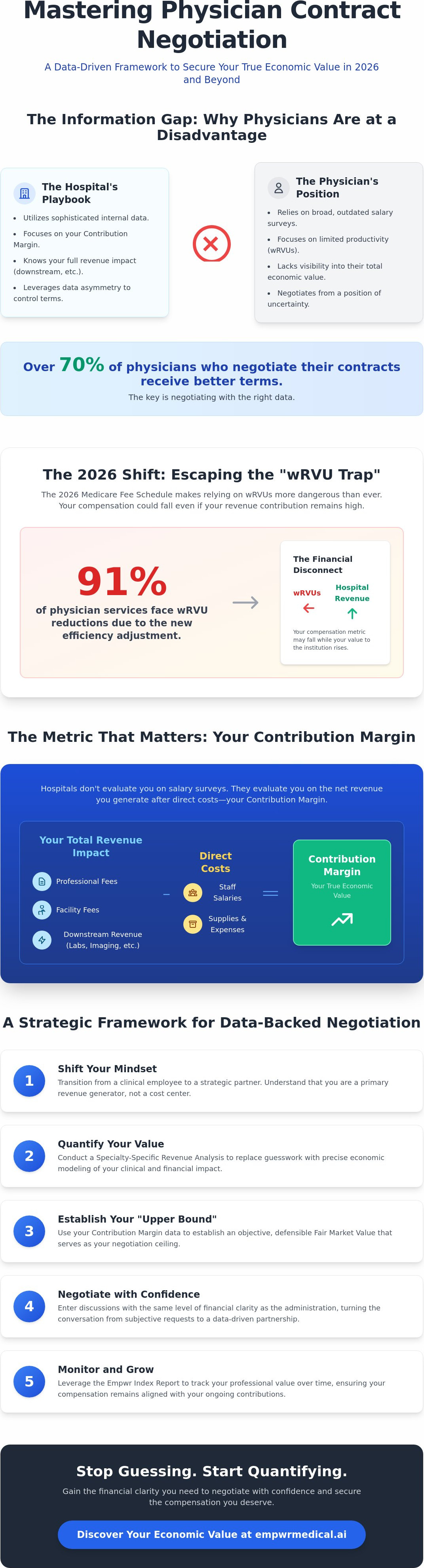
Over 70% of physicians who negotiate their contracts receive better terms, yet most clinicians still enter the boardroom at a significant information disadvantage. While hospitals use sophisticated data to protect their bottom lines, you're often left relying on broad market averages that fail to capture your specific impact. It's understandable to feel a sense of unease regarding physician contract negotiation, especially as the 2026 Medicare Physician Fee Schedule introduces an efficiency adjustment that reduces wRVUs for 91% of services.
You recognize that your professional worth extends far beyond a simple productivity metric, but translating clinical excellence into economic leverage remains a complex challenge. We'll help you bridge this gap by replacing subjective benchmarks with rigorous, objective data. You'll learn how to move past the 2026 average starting salary of $403,000 to advocate for a contract that reflects your true contribution margin and clinical value.
This guide provides a methodical framework for mastering your next negotiation using a Specialty-Specific Revenue Analysis. We'll show you how to utilize the Physician Economic Value Platform and the Empwr Index Report to gain the quiet confidence that comes from having the same level of financial clarity as the institutions sitting across the table.
Key Takeaways
- Identify why traditional salary surveys often favor employers and how to shift your strategy toward real-time economic modeling.
- Understand the "wRVU trap" and why quantifying your contribution margin is essential for securing compensation that reflects your actual revenue impact.
- Execute a more effective physician contract negotiation by utilizing specialty-specific revenue analysis to establish your objective fair market value.
- Establish your economic "Upper Bound" by following a structured framework that translates clinical data into actionable negotiation leverage.
- Leverage the Empwr Index Report to monitor your professional value over time and ensure your compensation remains aligned with your ongoing contributions.
The Evolution of Physician Contract Negotiation: From Surveys to Strategy
The landscape of 2026 has fundamentally altered how clinicians approach their professional agreements. For decades, physician contract negotiation followed a predictable, if flawed, pattern. Doctors would enter meetings armed with annual salary surveys, while hospital administrators relied on their own internal benchmarks. This created a persistent information asymmetry. Hospitals possess granular data on collections, overhead, and payer mix, while physicians are often restricted to static, third-party averages. This imbalance inevitably leads to compensation packages that fail to reflect the actual economic value a clinician brings to the system.
To level the playing field, you must move beyond the role of a clinical employee and adopt the mindset of a strategic partner. This requires a transition from asking for a raise to conducting informed conversations based on the fundamental principles of negotiation. By utilizing the Physician Economic Value Platform, you can replace guesswork with precise economic modeling. Success in 2026 depends on your ability to quantify your worth before the first meeting begins.
The Limitations of Traditional Salary Benchmarks
Relying on legacy surveys like MGMA presents significant risks in a rapidly shifting market. These reports often reflect data that is 12 to 18 months old, making them poorly suited for the 2026 environment where Medicare efficiency adjustments have already impacted wRVU valuations. National averages also fail to account for location-adjusted nuances or specific specialty demands. Administrators frequently use survey medians as a "ceiling" to cap compensation, rather than viewing them as a baseline for high-performing clinicians. Static numbers simply cannot keep pace with your actual clinical output.
Moving Toward Clinical Economic Transparency
True leverage comes from quantifying your specific impact on the health system's bottom line. You aren't just a cost center; you're a primary revenue generator. Shifting toward transparency means translating your clinical workload into a clear Specialty-Specific Revenue Analysis. When both parties understand the actual contribution margin, the conversation changes. It's no longer about subjective feelings of fairness. Instead, it becomes a data-driven discussion about how your clinical output sustains the facility’s operational health. This clarity is the cornerstone of a modern physician contract negotiation, fostering a sustainable partnership where compensation is tied directly to documented economic contribution.
Decoding Hospital Economics: Why Contribution Margin Trumps wRVUs
While many physicians focus exclusively on their base salary or signing bonuses, hospital administrators analyze a much more complex metric behind closed doors: the contribution margin. This figure represents the revenue remaining after all direct variable costs associated with your clinical work are covered. It's the primary indicator of your financial viability within a health system. Relying solely on productivity metrics during a physician contract negotiation often means leaving significant value on the table because it ignores the broader institutional revenue you generate.
The 2026 Medicare Physician Fee Schedule has introduced an efficiency adjustment that reduces work relative value units (wRVUs) for 91% of physician services. This change makes the "wRVU Trap" more dangerous than ever. If your compensation is tied strictly to wRVU production, your pay could stagnate or decrease even as the revenue you generate for the hospital remains high. To secure a fair agreement, you must look beyond work effort and calculate your physician economic value score to bridge the data gap between your clinical output and the facility's financial gain.
The Math Behind the Margin
Understanding your margin requires a deep dive into the split between professional fees and facility fees. While you see the professional fee as your primary output, the hospital often captures a much larger facility fee for the same encounter. Additionally, your clinical decisions drive significant downstream revenue through diagnostic imaging, laboratory tests, and surgical referrals. A Specialty-Specific Revenue Analysis can help you uncover these hidden financial streams, moving the conversation from what you "cost" to how much profit you "contribute." For a more precise look at these variables, you can explore how a Physician Economic Value Platform translates complex billing data into negotiation leverage.
wRVUs vs. Economic Value: A Comparison
wRVU conversion factors are frequently manipulated by institutions to keep compensation within certain percentiles, regardless of the actual collections. For example, primary care conversion factors typically range from $45 to $60 per wRVU, while surgical specialties may see $90 or more. However, these rates don't account for the "value gap" between your total collections and your base pay. Contribution margin is the ultimate leverage in 2026 because it represents the actual liquid value you provide to the institution's financial ecosystem. By identifying this gap, you can enter your physician contract negotiation with the quiet confidence that your requests are backed by the hospital's own economic reality.
Evaluating Negotiation Tools: Survey Data vs. Economic Modeling
The primary challenge in 2026 isn't a lack of information, but the quality and perspective of the information you bring to the table. Traditional surveys like MGMA and SullivanCotter are the historical standard, but they represent a backward looking view of the market. These datasets are often aggregated from employer reported figures, which can lead to a systemic bias toward lower compensation medians. In contrast, economic modeling through the Physician Economic Value Platform provides a forward looking, clinician centric perspective. To succeed in physician contract negotiation, you must understand the distinction between static benchmarks and dynamic revenue modeling.
Access to accurate physician fair market value data is no longer optional. Regulatory scrutiny has intensified, with the OIG clarifying in April 2026 that Stark Law compliance doesn't automatically shield an arrangement from Anti-Kickback Statute violations. If your compensation exceeds the 75th percentile without objective economic justification, the hospital's legal team will likely label it a compliance risk. You need data that proves your compensation is commensurate with the revenue you generate, specifically in procedural fields where the gap between work effort and facility collections is widest.
The Case for CMS and RAND Data Sources
While private surveys rely on self reporting, CMS fee schedules offer an objective, transparent baseline for every specialty. Integrating RAND pricing data allows you to see how commercial payers in your specific region multiply these CMS rates. This creates a much more accurate picture of your true market value than a national average. Geographic adjustments, such as the Geographic Practice Cost Index (GPCI), ensure your data reflects the high cost or high demand reality of your specific location. These sources provide the "green lights" needed to justify higher compensation tiers during a physician contract negotiation.
Choosing the Right Software for Your Career Stage
Whether you're a resident signing your first agreement or a senior partner renegotiating a legacy contract, you need "decision ready" reporting. Your time is better spent in the clinic than in a spreadsheet. A robust valuation platform should automate the heavy lifting of data aggregation and translation. By integrating specialty specific revenue analysis into your presentation, you present a professional, data backed pitch deck that speaks the language of the C-suite. This level of preparation signals that you're a sophisticated professional who understands the economic mechanics of modern healthcare systems.
A Strategic Framework for Data-Backed Negotiation
Executing a successful physician contract negotiation requires moving from defensive posturing to proactive strategy. While hospitals rely on institutional inertia, your strength lies in the precise quantification of your clinical and economic output. By following a structured framework, you can transform the conversation from a request for better terms into a professional presentation of mutual economic benefit. This process ensures that your compensation isn't just a reflection of market averages, but a direct result of your specific contribution margin.
- Step 1: Quantify Impact. Use objective benchmarks from CMS and RAND to establish a baseline of your clinical productivity.
- Step 2: Calculate the Upper Bound. Determine the revenue remaining after direct variable costs to find the maximum sustainable compensation the health system can offer.
- Step 3: Adjust for Location. Apply geographic cost indices to ensure your fair market value reflects the specific economic realities of your practice area.
- Step 4: Summarize Value. Utilize the Empwr Index to present a single, data-backed score that represents your total economic impact.
- Step 5: Address the Total Package. Shift focus to the full compensation structure, including the 2026 average signing bonus of $38,000 and value-based incentives.
To begin building your data-backed case, you can access your customized Physician Economic Value Platform to generate the necessary reporting for these steps.
Negotiation for Residents and Fellows
Your first agreement often dictates the financial trajectory of your entire career. While you lack a long billing history, you possess significant leverage through your potential and the persistent physician shortage. Instead of accepting a "standard" offer, use a physician contract negotiation for residents strategy to benchmark your offer against projected revenue. This allows you to negotiate from a position of economic clarity rather than relying on anecdotal advice from peers.
Renewal Strategies for Established Attendings
For the established clinician, a physician contract negotiation is an opportunity to correct the "value gap" created by hospital mergers or inflation. Use your historical billing data to demonstrate how your practice has matured beyond the initial guarantees. A successful physician contract renewal negotiation identifies hidden value like administrative leadership and call coverage, ensuring these contributions are quantified and compensated according to current 2026 market standards.
Leveraging the Empwr Index for Career Longevity
Securing a favorable agreement is only the first phase of a sustainable career strategy. In the shifting healthcare economy of 2026, professional longevity requires more than a single successful physician contract negotiation; it demands an ongoing, data-driven posture. The Empwr Index Report distills complex financial variables, from your contribution margin to geographic fair market value, into a single, authoritative score. This metric serves as a North Star for your career, allowing you to monitor your economic impact with the same precision you apply to clinical outcomes.
Adopting the role of a "rigorous advocate" means moving beyond the reactive cycle of waiting for a contract to expire before assessing your worth. By utilizing recurring financial reporting, you ensure that your compensation remains aligned with the actual revenue you generate for the institution. This transparency fosters a sense of fairness and mutual respect, positioning you as a strategic partner who understands the operational realities of the health system. When you lead with objective evidence, you eliminate the emotional friction that often characterizes salary discussions.
Beyond the Initial Signature
You shouldn't wait for a formal renewal period to track your economic value. Annual assessments are vital as the industry moves toward hybrid compensation models that combine base salary with value-based incentives. These models increasingly prioritize quality, patient satisfaction, and cost-efficiency metrics. Having a continuous stream of data allows you to pivot your strategy as these benchmarks evolve. Furthermore, clinical data acts as a powerful hedge against burnout. Much of the frustration in modern medicine stems from a perceived lack of agency or a feeling that professional contributions are undervalued. Quantifying your impact provides the psychological validation that your work is both clinically essential and economically significant.
The Empwr Medical Advantage
The Physician Economic Value Platform provides the infrastructure needed for these informed conversations. By accessing your specialty-specific revenue report, you gain a granular understanding of how your specific workflows, from diagnostic referrals to procedural facility fees, impact the bottom line. This level of detail is what separates a standard clinician from a high-level professional who commands a contract reflecting their true contribution. The goal isn't just to get paid more; it's to ensure the system recognizes the full scope of the value you provide. It's time to move past the information asymmetry of the past and embrace a future grounded in economic clarity. Quantify your value and secure your future with Empwr Medical to ensure your next physician contract negotiation is backed by the steady assurance of rigorous data.
Securing Your Economic Value in a Shifting Market
The healthcare landscape of 2026 demands a departure from traditional, survey-based advocacy. You've seen how shifting your focus from simple productivity metrics to a comprehensive contribution margin provides the ultimate leverage. By quantifying the downstream revenue and facility fees associated with your clinical output, you transform the physician contract negotiation from a standard administrative hurdle into a strategic partnership. It's no longer about asking for what you're worth; it's about presenting the data that proves it.
Success requires data that mirrors the sophistication of the health systems you serve. Empwr Medical provides this clarity through modeling that is specialty-specific, location-adjusted, and grounded in authoritative CMS and RAND datasets. As a physician-led organization, we understand the nuances of your clinical workflow and the necessity of objective fair market value reporting. Don't enter your next meeting with outdated benchmarks or anecdotal evidence. Take control of your professional trajectory by utilizing a platform designed to bring hidden economic truths to light.
Generate Your Empwr Index Report and Negotiate with Confidence
Your expertise is the foundation of the healthcare system. It's time your contract reflected that reality.
Frequently Asked Questions
How do I start a physician contract negotiation if I don’t like confrontation?
You should frame the discussion as a collaborative review of economic value rather than a personal confrontation. By presenting an objective Specialty-Specific Revenue Analysis, you allow the data to speak for itself. This shifts the tone from a subjective demand to a professional, informed conversation about business logic and clinical impact. It’s an approach that relies on evidence rather than verbal sparring to reach a fair conclusion.
Can I negotiate my salary if the hospital says it is based on MGMA data?
Yes, you can negotiate by highlighting that static surveys often lag behind current market realities. MGMA data is frequently 12 to 18 months old and may not reflect the 2026 Medicare efficiency adjustments that reduced wRVUs for 91% of services. You should counter these averages with real-time economic modeling that shows your specific contribution margin and the actual revenue you generate for the facility today.
What are the most common mistakes in physician contract negotiation?
The most frequent error is entering a physician contract negotiation without quantifying downstream revenue and facility fees. Many clinicians focus strictly on their base salary or wRVU conversion factors while ignoring the broader financial impact of their referrals and diagnostic orders. Failing to understand your contribution margin often results in accepting a package that is significantly lower than the actual economic value you provide to the health system.
How much weight should I put on the sign-on bonus vs. the base salary?
You should prioritize the base salary because it serves as the foundation for future raises and retirement contributions. While the average 2026 signing bonus across all specialties is $38,000, a higher base salary provides compounding financial benefits over your entire career. Bonuses are one-time payments that don't increase your long-term earning potential, whereas a higher base pay sets a more favorable trajectory for every subsequent contract renewal.
What is the "Empwr Index" and how does it help in negotiations?
The Empwr Index is a proprietary score that translates your clinical output, location-specific data, and revenue generation into a single, authoritative metric. It simplifies complex financial reporting into a "decision-ready" format that hospital administrators can easily interpret. This report provides the quiet confidence needed to justify higher compensation tiers by proving your requests are commensurate with the hospital’s own economic gains.
Is it worth hiring a lawyer for physician contract negotiation?
It’s prudent to have a legal professional review your contract for restrictive covenants or unfavorable termination clauses. However, most lawyers lack the specialty-specific revenue data required to argue for higher compensation based on economic value. You should pair a legal review with the Physician Economic Value Platform to ensure your contract is both legally sound and financially reflective of your true contribution margin.
How do I calculate my contribution margin as a primary care physician?
Calculating your margin involves identifying your professional fees alongside the downstream revenue generated from diagnostic tests and specialty referrals. You must also account for any value-based incentives or care management fees tied to your patient panel. Our Specialty-Specific Revenue Analysis automates this complex calculation, providing a clear picture of the total financial ripple effect your practice has on the institution’s bottom line.
What happens if the hospital refuses to negotiate based on my data?
If an institution refuses to acknowledge objective economic evidence, it indicates a fundamental lack of alignment regarding your professional value. Having a clear report on your contribution margin gives you the confidence to walk away or seek out an organization that values data-driven transparency. Over 70% of physicians who negotiate their contracts receive better terms, so persistence backed by rigorous evidence remains your most effective strategy.