

While the average physician starting salary climbed to $403,000 in 2026, many specialists find that standard benchmarks fail to capture their true contribution to a hospital's bottom line. Relying on generic data often leads to feeling undervalued, which is why a structured physician value proposition template is essential for your next contract discussion. It's difficult to argue for better terms when you're measured against national averages that don't account for your specific procedural efficiency or the revenue you generate for your system.
You've likely experienced the frustration of presenting clinical quality metrics only to have administrators pivot back to rigid financial data you can't access. It's an uneven playing field that leaves you defending your worth rather than demonstrating your ROI. We believe that transparency is the foundation of a fair contract, and we're here to help you bridge the gap between clinical excellence and economic clarity.
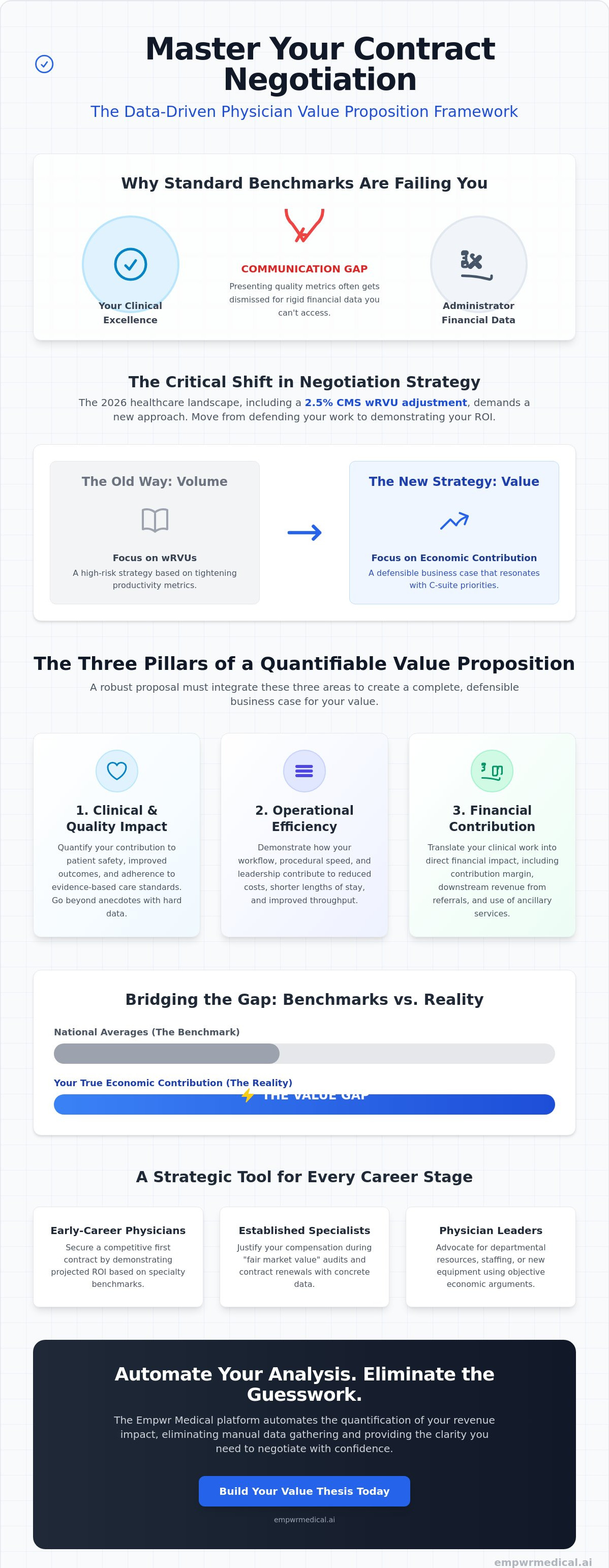
This guide will show you how to master your next negotiation with a data-backed framework that translates clinical workload into clear economic value. We'll explore how to navigate the 2.5% wRVU efficiency adjustment implemented by CMS and provide the exact metrics you need to justify a higher salary or improved terms with absolute confidence.
Key Takeaways
- Shift your negotiation strategy from volume-based claims to value-based arguments that align with the 2026 healthcare economic landscape.
- Implement a professional physician value proposition template to translate clinical excellence and operational efficiency into a quantifiable financial impact.
- Recognize the limitations of lagging industry benchmarks and learn to present data that reflects your actual contribution margin rather than national averages.
- Follow a structured, step-by-step methodology to build a "Value Thesis" that bridges the gap between your clinical workload and hospital-side revenue.
- Leverage tools like the Physician Economic Value Platform to automate the quantification of your revenue impact and eliminate the burden of manual data gathering.
What is a Physician Value Proposition and Why is it Essential?
A physician value proposition is a formal, evidence-based statement that quantifies your clinical, operational, and financial impact within a health system. It moves beyond the anecdotal and anchors your professional worth in objective data. To understand the foundation of this concept, one might look at the broader business definition of What is a Value Proposition, which describes how a service solves a specific problem or delivers measurable benefits. In a medical context, this means proving you aren't merely a cost center, but a primary driver of institutional stability and growth.
The 2026 fiscal landscape has made this shift from volume to value mandatory. With the Centers for Medicare & Medicaid Services (CMS) implementing a 2.5% efficiency adjustment that reduces work RVUs for over 7,000 CPT codes, relying on clinical volume alone is a high-risk strategy. As productivity metrics tighten, you must pivot toward economic arguments that resonate with C-suite priorities. Utilizing a physician value proposition template allows you to present a "Value Thesis" that administrators cannot easily dismiss. It transforms a subjective conversation about "fairness" into a rigorous analysis of your total ROI. This structured approach is the most effective method for quantifying physician value during high-stakes contract renewals.
A structured template also levels the playing field. Hospital administrators enter negotiations armed with proprietary financial data and sophisticated benchmarking tools. Without a counter-framework, you're at a distinct disadvantage. By organizing your contributions into a professional document, you shift the power dynamic. You move from a position of requesting a salary increase to a position of demonstrating why a specific compensation level is a sound financial investment for the hospital.
The Shift from wRVUs to Economic Contribution
Many physicians make the tactical mistake of focusing solely on physician relative value units explained through standard productivity reports. While wRVUs measure clinical effort, they don't reflect the "Contribution Margin," which is the revenue remaining after variable costs are covered. Administrators prioritize this margin and downstream revenue, such as ancillary imaging or surgical referrals, over gross charges. To negotiate effectively, you need location-adjusted data that proves your specific contribution to the hospital's financial health. Clarity in these numbers provides the steady assurance needed for a successful outcome.
Who Should Use This Template?
This framework is a strategic tool designed for physicians at various career milestones:
- Early-career physicians: Secure a competitive first contract by demonstrating projected ROI based on specialty benchmarks.
- Established specialists: Defend your compensation during "fair market value" audits or prepare for a contract renewal.
- Physician leaders: Advocate for departmental resources, staffing increases, or new equipment by using objective economic data.
A physician value proposition template provides the transparency required to lead these informed conversations with confidence.
The Three Pillars of a Quantifiable Physician Value Proposition
A successful negotiation requires more than just a list of clinical duties; it demands a multifaceted argument built on three distinct pillars. If you focus exclusively on clinical volume while ignoring operational leadership or financial margins, your proposal will lack the depth needed to sway hospital leadership. A robust physician value proposition template must integrate clinical excellence, operational efficiency, and financial contribution to create a defensible business case. Failing to address any one of these areas leaves a gap that administrators can use to justify lower compensation ceilings or generic benchmarks.
Quantifying Clinical and Quality Impact
While patient satisfaction scores offer a glimpse into your practice, they are often viewed as subjective by hospital boards. To build a rigorous case, you must translate clinical quality into measurable outcomes that affect the hospital's bottom line. High-quality care directly reduces institutional costs by lowering readmission rates and shortening the Length of Stay (LOS). When you align your clinical strengths with the health system’s strategic goals, such as meeting specific safety targets, you prove your role in the shift toward Benchmarking vs. True Economic Value. This data-driven approach moves the conversation from your "reputation" to your documented impact on patient safety and cost containment.
Operational and Strategic Contribution
Your value extends far beyond the exam room or the operating suite. Operational value is the optimization of institutional resources through clinical leadership. This includes your time spent in medical directorships, program development, or mentoring junior faculty. Administrators also look for the "halo effect," which is the way your presence stabilizes a service line or attracts other high-performing providers to the facility. These contributions are often overlooked because they don't generate wRVUs, yet they are essential for the long-term viability of the department. Quantifying these roles ensures that your strategic worth is recognized alongside your clinical output.
The Financial Pillar: Contribution Margin
The most persuasive metric for a Chief Financial Officer (CFO) is your contribution margin. This figure represents the total revenue you generate for the system minus the direct variable costs of your practice. It provides a much clearer picture of your economic worth than gross charges or collections alone. By utilizing a specialty specific revenue analysis, you can identify the downstream revenue you drive through ancillary services and referrals. If you are unsure of how to access these figures, using Empwr Medical’s data solutions can help you uncover the hidden financial truths that anchor your market value. This financial clarity is the final piece of the puzzle, providing the objective evidence needed to justify a compensation package that reflects your true professional standing.
Benchmarking vs. True Economic Value: Identifying the Gap
Standard salary surveys from national benchmarking organizations are the traditional starting point for negotiations, but they're fundamentally lagging indicators. By the time you sit down for a 2026 contract discussion, the data in these reports often reflects clinical cycles from 2024 or 2025. This creates a significant disconnect between your current productivity and the benchmarks used to justify your pay. A robust physician value proposition template must account for this delay by prioritizing real-time economic impact over historical averages. Relying solely on these surveys often results in a "Value Gap," where your compensation fails to reflect the actual revenue you generate for the system today.
Administrators frequently use Fair Market Value (FMV) as a compliance-based ceiling to cap compensation. You've likely heard the objection that a system can't pay above the 90th percentile due to regulatory risks. However, this is often a defensive posture rather than a legal absolute. If your economic contribution, measured by contribution margin and downstream revenue, also sits in the 90th percentile or higher, a compensation package at that level remains within the bounds of FMV. Your goal is to provide the data that proves this alignment, turning a compliance hurdle into a justification for higher terms.
Why Salary Surveys Often Undervalue High Producers
Health systems often fall into the "Median Trap," using average data to suppress the earning potential of top-tier specialists. When you're a high producer, being compared to the 50th percentile is a mathematical disadvantage that ignores your efficiency and procedural volume. Utilizing physician economic profiling allows you to reveal the specific revenue streams that standard surveys overlook, such as high-acuity CPT mix or location-adjusted commercial reimbursement rates. In 2026, these nuances are critical as the wRVU efficiency adjustment begins to alter the traditional productivity landscape.
Using RAND and CMS Data to Counter Low Offers
To build a successful "Data Defense," you need sources that reflect the modern payer mix. RAND pricing data is an invaluable tool for this, as it highlights the significant gap between Medicare rates and commercial insurance reimbursements. While a hospital might cite CMS fee schedules to suggest a lower revenue ceiling, commercial payers often reimburse at 200% to 300% of those rates. By translating the 2026 CMS conversion factor of $33.40 into a projected revenue model for your specific CPT mix, you can demonstrate the true economic throughput of your practice. This level of granular detail makes it difficult for administrators to rely on arbitrary productivity caps during your negotiation.
The Physician Value Proposition Template: A Step-by-Step Implementation
Executing a successful negotiation requires a transition from clinical reporting to strategic advocacy. A professional physician value proposition template provides the necessary structure to guide administrators through your economic and operational narrative. By following a methodical five-step process, you ensure that every claim is anchored in objective evidence rather than subjective preference.
Step one involves drafting an executive summary that centers on your "Value Thesis." In three concise sentences, you must state your clinical mission and how that mission drives institutional stability. Step two focuses on the evidence, where you present a physician financial impact analysis for hospitals. This section should utilize clear charts to visualize revenue growth and cost-containment successes. Step three requires strategic alignment, connecting your specific specialty goals to the hospital's 2026 growth plan. Step four defines the proposal, clearly stating your requested compensation and necessary resources. Finally, step five demonstrates the ROI, showing the system exactly what they gain by accepting your terms.
Structuring Your Executive Summary
Your "Value Thesis" is the most critical part of the document because it sets the tone for the entire conversation. It should balance clinical quality with financial sustainability, proving that your presence is an asset to both patients and the balance sheet. Lead with your strongest metric immediately. If you have achieved a 25% growth in service line revenue or a significant reduction in length-of-stay metrics, that data belongs in the first paragraph. Keep the summary focused on institutional benefits; administrators are tasked with solving system-wide problems, and your proposal should be framed as the solution.
Visualizing the Data: Tables and Charts
Financial data is most persuasive when it is "decision-ready," meaning it requires minimal interpretation from the reader. Use a "Contribution Margin Analysis" table to show the revenue you generate minus direct costs. It is essential to contrast your performance against both national and regional benchmarks to provide context for your productivity. Use a comparison table to show your current state versus your proposed state to highlight the modest nature of your request relative to the value you provide. To simplify this process and generate these visuals instantly, you can access the Physician Economic Value Platform for specialty-specific clarity.
Closing the Deal: The Strategic ROI
The final section of your physician value proposition template must address the hospital's risk. Quantify the significant cost of physician turnover, which often reaches hundreds of thousands of dollars in lost revenue and recruitment fees, against the relatively small cost of your requested increase. Highlight non-monetary value such as your role in mentorship, leadership committees, or your reputation in the community. Close the document by defining the "Next Steps," such as a follow-up meeting with the CFO or a timeline for contract finalization, to ensure the momentum of the conversation continues toward a signature.
Automating Your Value Analysis with Empwr Medical
Manual data gathering is often the primary obstacle to a successful negotiation. Physicians rarely have access to the backend billing data or the actuarial expertise required to calculate their true contribution margin. This information asymmetry creates a power imbalance where the hospital holds the majority of the strategic leverage. While a physician value proposition template provides the necessary structure, the data that populates it must be accurate and authoritative to withstand C-suite scrutiny. Without objective evidence, even the most well-structured argument can be dismissed as subjective.
The Physician Economic Value Platform removes this barrier by translating clinical volume into actionable revenue estimates instantly. It uses a sophisticated modeling engine to bridge the gap between your wRVU output and the actual economic throughput of your practice. By integrating specialty-specific workflows, the platform ensures that no revenue stream, such as ancillary referrals or downstream procedural impact, is left off the table. This transparency allows you to walk into a meeting with a clear understanding of your ROI, transforming the negotiation into an informed conversation about shared financial goals.
At the center of this analysis is the "Empwr Index," a single, authoritative score designed to anchor your entire negotiation. This index provides a standardized way to communicate your value, ensuring that your request remains aligned with Fair Market Value (FMV) and compliance standards. It acts as a bridge between your clinical contribution and the hospital's financial reality, providing the "quiet confidence" that comes from rigorous methodology.
The Power of the Empwr Index Report
The Empwr Index Report provides a professional, "CFO-ready" document that you can present directly to hospital leadership. It moves the conversation away from emotional appeals and toward a structured, data-backed discussion. For example, a surgical subspecialist recently utilized an Empwr Index report to demonstrate how their procedural efficiency outperformed regional benchmarks, ultimately securing a 15% increase in their base compensation. By presenting the data in a format that administrators already understand, you reduce the cognitive load on the decision-makers and accelerate the approval process. This report ensures that your physician value proposition template is supported by the highest standard of economic clarity.
Getting Started: Your Data-Driven Future
True professional advocacy requires continuous monitoring rather than a once-a-year effort. Your economic value is dynamic, shifting with changes in payer mix and CMS fee schedules. The platform provides access to CMS and RAND-backed insights without requiring a finance degree, allowing you to track your market standing in real-time. You don't have to wait for a contract renewal to understand your worth or identify a growing "Value Gap." You can calculate your true economic value and generate your report today to ensure your next conversation is backed by the steady assurance of data and strategic insight.
Securing Your Professional Value in a Data-Driven Market
The 2026 healthcare landscape requires you to be as precise with your financial data as you are with your clinical practice. By moving beyond lagging salary surveys and focusing on your true contribution margin, you can transform a standard contract review into a strategic partnership. Utilizing a structured physician value proposition template ensures that your clinical quality and operational leadership are visible to hospital leadership in a format they respect. This shift from volume to value is the most effective way to address the complexities of modern compensation models.
Empwr Medical provides the tools to automate this complex analysis. Our physician-led platform leverages authoritative CMS and RAND data sources to deliver specialty-specific revenue analysis for all major medical fields. It's designed to bring hidden truths to light, providing you with the objective evidence needed for expert-level negotiations. This approach replaces the uncertainty of generic benchmarks with the steady assurance of rigorous methodology and location-adjusted accuracy.
Generate your physician economic value report now at Empwr Medical to anchor your future in clarity. You've already done the hard work of building your value; now it's time to ensure you have the data to defend it with absolute confidence.
Frequently Asked Questions
What is a physician contribution margin?
The contribution margin is the total revenue you generate for a health system minus the direct variable costs associated with your practice. Unlike gross charges, this figure represents the actual surplus available to cover the hospital's fixed overhead and profit. Administrators and CFOs prioritize this metric because it provides a clear picture of your individual economic impact on the institution's bottom line.
How do I prove my value to a hospital if I don’t have access to their billing data?
You can use external modeling and specialty-specific benchmarks to estimate your economic impact. By utilizing a physician value proposition template populated with your CPT mix and procedural volume, you can apply CMS and RAND pricing data to project your revenue throughput. This approach allows you to present a credible financial narrative even when the hospital's internal data remains opaque.
Is it better to negotiate based on wRVUs or total revenue?
Negotiating based on total revenue and economic contribution provides significantly more leverage than wRVUs alone. While wRVUs measure clinical effort, total revenue reflects your actual impact on the hospital's financial health. This distinction is vital in 2026 as CMS implements a 2.5% efficiency adjustment that reduces wRVU values for many procedural codes, potentially decoupling effort from compensation.
What are the most important quality metrics to include in a value proposition?
Focus on metrics that directly influence institutional costs and strategic goals. Readmission rates, length of stay (LOS), and patient safety scores are highly persuasive because they impact value-based reimbursement and hospital efficiency. Aligning your clinical outcomes with these financial drivers proves that your work delivers both medical excellence and economic sustainability for the health system.
How often should I update my physician value proposition?
You should update your value proposition annually or whenever significant regulatory changes occur. Since the CMS conversion factor and wRVU weights shift each year, a static document quickly becomes obsolete. Maintaining a living physician value proposition template ensures you're always prepared for "fair market value" audits or sudden contract renewal discussions with the most current, location-adjusted data.
Can I use this template for a private practice partnership negotiation?
Yes, this framework is highly effective for defining your worth in a private practice setting. It helps you quantify your contribution to practice overhead and the ancillary revenue you drive through referrals and diagnostics. Proving your economic throughput is essential when discussing buy-in costs, equity distributions, or partnership tracks where your financial contribution must be clearly understood.
How does the Empwr Index differ from MGMA salary data?
The Empwr Index provides a real-time, revenue-focused analysis, whereas MGMA data is often a lagging indicator based on historical averages. While MGMA tells you what others were paid in the past, the Empwr Index focuses on the revenue you generate today. It incorporates the 2026 Medicare Physician Fee Schedule changes to ensure your valuation reflects current market realities rather than outdated surveys.
What should I do if the hospital refuses to look at my value proposition?
Frame the document as a tool for compliance and risk mitigation. Explain that the data ensures your compensation remains within Fair Market Value (FMV) guidelines, which protects the hospital from regulatory scrutiny. If they still refuse to engage with objective data, it indicates a lack of transparency that might suggest you should explore other opportunities where your economic contribution is respected.