

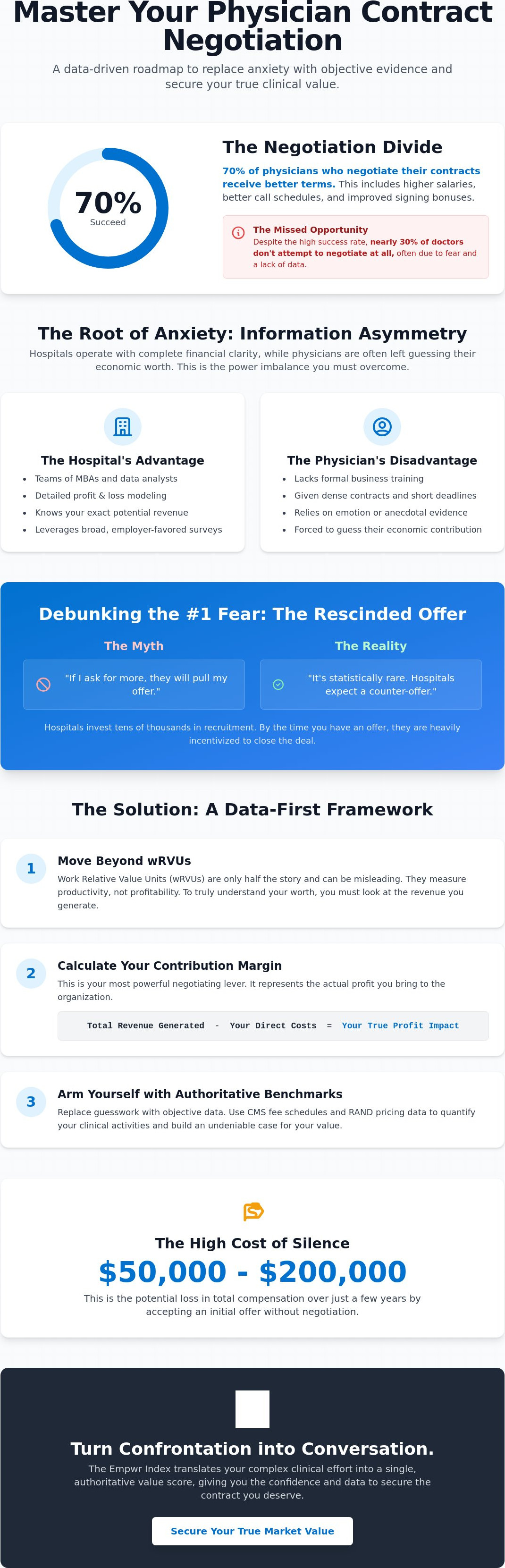
Did you know that 70% of physicians who negotiate their contracts receive better terms, yet nearly 30% of doctors don't even attempt to ask for more? It's natural to feel a deep-seated fear of negotiating physician contract terms. You likely worry that pushing for a higher signing bonus, which averages $38,000 in 2026, could cause a hospital to rescind your offer entirely. This hesitation often stems from a massive information asymmetry where the hospital knows its profit margins, but you're left guessing your own economic worth.
We're here to tell you that negotiation isn't a gamble; it's a data-driven exercise. You'll learn how to replace anxiety with objective evidence to secure a contract that reflects your true clinical value. This guide provides a strategic roadmap for your next meeting. We'll explore how to bridge the gap between clinical work and hospital revenue, using precise benchmarks to turn a stressful confrontation into a professional conversation. By the end, you'll have the confidence to walk into any negotiation armed with the facts needed to protect your long-term financial security and professional autonomy.
Key Takeaways
- Understand why the fear of negotiating physician contract terms is often based on the myth of rescinded offers rather than statistical reality.
- Move beyond work relative value units (wRVUs) to identify the specific productivity metrics that dictate your actual economic contribution to a hospital.
- Learn how to counter common employer posturing, including the "standard contract" defense and misconceptions regarding Stark Law compliance.
- Apply a data-first framework to calculate your contribution margin using authoritative industry benchmarks and revenue estimates.
- Discover how the Empwr Index translates complex clinical effort into a single, authoritative value score for more informed professional conversations.
Why Physicians Fear Contract Negotiations: Identifying the Power Imbalance
The fear of negotiating physician contract terms is often a byproduct of a system designed to prioritize institutional stability over individual physician value. Most clinicians graduate from residency with world-class medical training but almost no formal business education. This lack of exposure creates a "confidence gap" that hospitals often exploit. When an administrator presents a "standardized" contract, they're using a psychological tactic to suggest the terms are immutable. In reality, every contract is a modifiable business agreement. You aren't being "difficult" by requesting clarity on how your clinical work translates to hospital profit. You're acting as a diligent professional protecting your career longevity.
One of the most persistent myths is the rescinded offer. Many doctors stay silent because they worry the employer will walk away if they ask for a higher signing bonus or better call schedules. However, pulling an offer is statistically rare. Hospitals invest significant capital into the recruitment cycle, often spending tens of thousands of dollars on sourcing and vetting before an offer is even extended. By the time you have a contract in hand, the organization is incentivized to close the deal. They expect a counter-offer; it's a standard part of the professional landscape in 2026.
The Information Asymmetry Problem
Hospitals enter negotiations with teams of MBAs and data analysts who have spent months modeling your potential revenue. You, conversely, are often handed a dense PDF and a short deadline. This imbalance is compounded by a reliance on traditional salary surveys like MGMA. While these benchmarks provide a baseline, they often favor the employer by presenting broad averages that ignore your specific clinical efficiency or local market nuances. Without knowing your Best Alternative to a Negotiated Agreement (BATNA), you're forced to negotiate from a position of perceived weakness. Understanding your objective economic value is the only way to bridge this gap.
The Cost of Silence
Accepting a boilerplate agreement without pushback can lead to a staggering lifetime earnings gap. A 2026 Medscape report revealed that 27% of physicians felt negotiation wasn't even an option. This silence is expensive. Failing to negotiate an initial offer can result in a loss of $50,000 to $200,000 in total compensation over just a few years. Beyond the base salary, these contracts often hide rigid productivity requirements or unfavorable call schedules that compromise your professional autonomy. Negotiation isn't a professional standard that signals you understand your worth as a high-level clinician.
The Root of Negotiation Anxiety: Solving the Information Gap
Anxiety in a professional setting is rarely a personality trait; it's usually a symptom of missing information. When clinicians experience a fear of negotiating physician contract terms, it's often because they lack the verifiable economic data necessary to advocate for themselves. Without a clear understanding of the revenue they generate, physicians are forced to rely on emotion or anecdotal evidence. This puts them at a distinct disadvantage against hospital administrators who have spent months modeling the financial impact of every clinical hire. To eliminate this fear, you must replace subjective feelings with objective economic reality.
Most physicians are taught to view their value through the lens of work relative value units (wRVUs). However, productivity metrics only tell half the story. With the Centers for Medicare & Medicaid Services (CMS) proposing a 2.5% reduction in work RVU values for 2026, relying solely on these units is increasingly precarious. Understanding physician relative value units explained provides a necessary baseline, but it isn't the finish line. To truly understand your worth, you must look at your contribution margin. This is the total revenue you generate for the system minus your direct costs. This figure represents the actual profit you bring to the organization, which is the most powerful lever in any negotiation.
Translating Clinical Work into Economic Value
Your true market power is determined by a combination of CMS fee schedules and RAND pricing data. These benchmarks allow you to quantify how your specific clinical activities translate into downstream revenue, such as labs, imaging, and facility fees. Geography also plays a critical role. Rural and underserved areas often offer higher compensation to attract talent, yet many physicians fail to account for these location-adjusted nuances. By analyzing a Specialty-Specific Revenue Analysis, you can move beyond a simple base salary and see the full scope of your economic contribution to the health system.
The Power of Objective Evidence
In the boardroom, numbers win. Data-driven advocacy removes the personal friction that often leads to common negotiation pitfalls, such as poor planning or viewing the negotiation as a zero-sum game. When you use physician fair market value data to set a firm floor for your demands, you aren't just "asking for more." You're presenting a business case for a fair exchange of value. This level of transparency reduces defensive posturing from employers and builds a more collaborative relationship. It changes the dynamic from a confrontation into an informed conversation about shared professional goals.
Countering Employer Posturing with Economic Reality
Hospitals often utilize "standardized" language as a psychological barrier to discourage requests for better terms. When an administrator claims they have a "standard contract" that cannot be changed, they're rarely stating a legal fact. Instead, they're employing a negotiation tactic designed to minimize administrative overhead and keep compensation predictable for the institution. Every contract is a modifiable business agreement. If your fear of negotiating physician contract terms stems from this perceived rigidity, remember that "standard" is simply a starting point for a conversation, not a final decree.
A common institutional shield is the invocation of Stark Law. Employers may claim that federal regulations prevent them from paying more than a certain threshold. While Stark Law does require that compensation remains within Fair Market Value (FMV), it doesn't mandate that every physician in a specialty receives the same pay. By presenting objective data on your specific contribution margin, you can prove that a higher compensation package is still well within FMV. Data doesn't just ask for more; it justifies why a higher figure is legally and economically sound.
The "consistency across the practice" argument is another frequent hurdle. Administrators may argue that they must keep all surgeons or hospitalists at the same rate to maintain fairness. However, this ignores the reality that different physicians bring different economic inputs. If you have unique procedural skills, higher-than-average clinical efficiency, or a track record of generating significant downstream revenue, your compensation should reflect that specific value. Unique skillsets deserve unique compensation structures, and data is the bridge that translates clinical excellence into financial clarity.
Navigating Institutional "No" Levels
Most initial rejections come from recruiters or mid-level managers who lack the authority to approve major contract shifts. Identifying the actual decision-maker—often a CMO or CFO—is a critical step in moving past administrative posturing. Utilizing essential negotiation skills allows you to remain professional and persistent without appearing adversarial. This "quiet confidence" approach relies on the steady assurance of methodology rather than emotional appeals. When you let the data do the heavy lifting, you're no longer "asking"; you're presenting an informed business case.
Specialty-Specific Leverage
Generic salary surveys are insufficient because they fail to account for how your specific workflow impacts the hospital’s bottom line. A specialty specific revenue analysis is your most potent tool for countering low-ball productivity bonuses. By quantifying the facility fees and downstream revenue your work generates—such as labs, imaging, and inpatient stays—you reveal the hidden truths of your economic contribution. Proving your value through these granular metrics shifts the focus away from broad averages and toward the specific revenue you generate for the system.
How to Negotiate Your Contract: A Data-First Framework
Overcoming the fear of negotiating physician contract terms requires a transition from intuition to methodology. While legal reviews are a necessary defensive measure, they don't provide an offensive strategy for value capture. A data-first framework ensures you enter the room not as a supplicant, but as an informed partner. By following a structured process, you replace the emotional weight of "asking for more" with the logical necessity of "aligning value."
- Step 1: Aggregate Clinical Data: Collect your historical or projected workload metrics, including patient encounters, surgical cases, and procedural codes.
- Step 2: Calculate Contribution Margin: Use authoritative CMS fee schedules and RAND pricing data to determine the revenue your clinical effort generates minus direct operational costs.
- Step 3: Benchmark via the Empwr Index: Utilize an Empwr Index Report to benchmark your specific economic contribution against national and regional standards.
- Step 4: Strategic Alignment: Identify the hospital’s strategic needs, such as expanding a specific service line or improving access in a high-demand zip code, and align your value proposition with these goals.
- Step 5: Execute the Conversation: Transition into the meeting using proven physician contract negotiation strategies that prioritize data over demands.
Preparing Your Value Proposition
Your value proposition should be a concise summary of your economic impact. Instead of abstract claims about clinical quality, focus on "commercially reasonable" compensation backed by transparent data sources. Hospitals are risk-averse; they're more likely to approve a higher salary or a $38,000 signing bonus when they can see the exact revenue modeling that justifies the expenditure. Presenting your findings as a collaborative business case reduces defensiveness and positions you as a professional who understands the operational realities of modern healthcare.
The Negotiation Conversation
The phrasing you choose during the meeting can either escalate tension or foster cooperation. Replace subjective statements like "I feel I should get a higher bonus" with data-driven anchors such as "Based on the specialty-specific revenue analysis, my projected contribution margin supports this adjustment." If the administrator meets your request with silence, don't rush to fill the gap. Strategic patience allows the other party to process your evidence. Recruiters often use short deadlines or "artificial urgency" to force a quick signature. When this happens, remind yourself that the data remains valid regardless of the timeline, and a well-informed decision is always superior to a rushed one.
Leveraging the Empwr Index to Secure Your True Market Value
Transitioning from a theoretical understanding of value to a successful negotiation requires a centralized source of truth. The Physician Economic Value Platform provides this clarity by translating granular clinical effort into transparent revenue estimates. This systemic approach directly addresses the fear of negotiating physician contract terms by replacing ambiguity with an Empwr Index score. It's a single, authoritative metric that benchmarks your contribution against national and regional standards. Moving beyond quantifying physician value allows you to execute a career strategy rooted in economic reality rather than institutional hope.
The platform functions as a bridge between your clinical workflow and the hospital's financial ledger. By inputting specialty-specific data, you receive a rigorous analysis of your contribution margin. This calculation accounts for the 2.5% reduction in work RVU values proposed by CMS for 2026, ensuring your expectations are aligned with the most current regulatory environment. When you possess a clear revenue estimate, the negotiation shifts from a request for more money to a professional discussion about fair value exchange.
The Empwr Index Advantage
The platform utilizes location-adjusted data for pinpoint accuracy, acknowledging that a surgeon in an urban center faces different economic realities than one in a rural market. Traditional salary surveys often suffer from reporting lag and participation bias. In contrast, the Empwr Index methodology relies on the same RAND and CMS data sets used by hospital finance departments to model profitability. This alignment ensures that the reports you generate are "decision-ready" for administrators. It removes the need for debate over data validity and focuses the conversation on the documented revenue you generate for the system.
Beyond the Initial Signature
Valuation is not a one-time event; it's an ongoing professional necessity. Secure contracts require continuous monitoring of your economic impact throughout the year. By maintaining a record of your contribution margin, you enter annual renewals with a documented history of success rather than a list of grievances. The platform allows you to track how shifts in patient volume or payer mix affect your overall value score. This longitudinal data is your best defense against compensation stagnation and the "wRVU trap" that many physicians face as reimbursement models evolve. Quantify your value and negotiate with confidence using Empwr Medical.
Secure Your Professional Future Through Economic Clarity
The fear of negotiating physician contract terms is a barrier that fades when confronted with rigorous data. You've seen how institutional posturing relies on information gaps. You now understand that your clinical contribution is quantifiable. By moving beyond basic salary surveys and focusing on your specific contribution margin, you transform a stressful meeting into a professional conversation about value. Negotiation isn't about being difficult. It's about ensuring your contract reflects the objective reality of the revenue you generate.
Empwr Medical was designed by physicians, for physicians, to bridge the gap between clinical excellence and economic transparency. Our platform utilizes location-adjusted and specialty-specific accuracy to provide a clear valuation score. These reports are backed by authoritative CMS and RAND sources. This gives you the evidence needed to counter employer posturing. You don't have to guess your worth or settle for boilerplate terms when you can rely on the steady assurance of methodology.
Negotiate with quiet confidence; get your Empwr Index Report today. Take control of your career trajectory and ensure your professional autonomy is protected by the truth of your economic contribution.
Frequently Asked Questions
Can a hospital really rescind an offer if I try to negotiate?
It's statistically rare for a hospital to rescind an offer simply because a physician initiates a professional negotiation. Recruitment cycles are expensive and time-consuming; organizations are highly incentivized to close the deal once they've selected a candidate. A respectful, data-backed counter-offer is a standard professional expectation in healthcare administration. Most employers view negotiation as a sign of a candidate who understands their professional value.
How do I know if my physician contract is "commercially reasonable"?
Commercial reasonableness is determined by whether your compensation aligns with the economic value you generate while adhering to Fair Market Value (FMV) standards. This assessment requires comparing your specific workload and revenue production against objective industry benchmarks like CMS and RAND. If your total compensation is supported by documented contribution margin data, it's generally considered commercially reasonable and legally compliant under federal regulations.
What is the difference between wRVUs and contribution margin?
Work Relative Value Units (wRVUs) measure clinical effort based on procedure complexity, while contribution margin measures the actual profit you generate for the system. With the 2.5% reduction in work RVU values proposed for 2026, wRVUs are becoming a less reliable indicator of total value. Contribution margin is a more comprehensive metric because it accounts for total revenue minus your direct operational costs.
Is it worth negotiating if the recruiter says the contract is "standard"?
Yes, because the "standard contract" is a common negotiation tactic used to discourage modifications, not a legal requirement. Every contract is a modifiable business agreement that can be adjusted based on your unique skillsets or specific market demand. Overcoming the fear of negotiating physician contract terms starts with recognizing that institutional boilerplate is merely a starting point for a professional conversation.
How can I calculate my own revenue generation for a hospital?
You can calculate your revenue generation by aggregating your clinical volume and applying CMS fee schedules and RAND pricing benchmarks to those metrics. This process involves tracking patient encounters, procedures, and downstream revenue such as imaging, labs, and facility fees. Using a specialized valuation platform allows you to translate these complex clinical activities into precise revenue estimates that hospital administrators can easily verify.
What data sources are most authoritative for physician fair market value?
The most authoritative sources for valuation are objective data sets from the Centers for Medicare & Medicaid Services (CMS) and the RAND Corporation. Unlike traditional salary surveys that rely on self-reported averages, these sources provide rigorous, verifiable benchmarks for reimbursement and operational costs. They offer the most accurate baseline for location-adjusted and specialty-specific valuation in the current 2026 regulatory environment.
When is the best time to start negotiating a contract renewal?
You should begin the renewal conversation six to nine months before your current contract expires. This timeline provides the necessary leverage to explore other professional options if the proposed terms are unfavorable. It also gives you enough time to compile a continuous record of your contribution margin to justify compensation adjustments based on your actual economic performance during the previous term.
Do I need a lawyer and a data platform for my negotiation?
A lawyer provides defensive protection by reviewing legal clauses, while a data platform provides an offensive strategy for value capture. Combining a legal review with objective economic data ensures you're protected from unfavorable terms while also securing compensation that reflects your true market value. Both tools are essential for a comprehensive strategy that prioritizes long-term financial security and professional autonomy.