

According to 2026 reports, over 70% of physicians who negotiate their employment contracts secure improved terms, yet nearly 30% of doctors feel that negotiation isn't even an option. This disconnect often stems from a profound information asymmetry that limits your physician negotiation leverage. You likely feel the pressure of medical cost inflation, which is projected at over 8% for 2026, while struggling to translate your complex clinical workload into a clear revenue figure. It's frustrating to provide high-value care without having the objective data to prove your worth during a high-stakes meeting.
Establishing your professional worth doesn't require an aggressive personality or confrontational tactics. This guide will show you how to replace negotiation anxiety with objective authority by quantifying your precise economic value to a healthcare system. We'll examine how to move past generic benchmarks and use specialty-specific revenue analysis to build a case grounded in rigorous evidence. You'll gain a clear framework to navigate these conversations with the confidence that only granular, location-adjusted data can provide.
Key Takeaways
- Overcome information asymmetry by redefining negotiation confidence as the intersection of your clinical impact and economic transparency.
- Identify why CMS fee schedules and authoritative valuation data provide a more rigorous baseline for revenue estimation than traditional, self-reported survey benchmarks.
- Calculate your contribution margin to establish sustainable physician negotiation leverage grounded in your true economic value to the healthcare system.
- Adopt a structured framework for informed conversations that shifts the negotiation dynamic from adversarial bargaining to collaborative, data-driven planning.
- Utilize the Empwr Index to remove emotional bias from the process and develop a long-term strategy for your professional and financial advancement.
Why Physicians Lack Confidence in Physician Negotiation Leverage
Negotiation confidence is frequently misunderstood as a personality trait. For a high-level clinician, true confidence is the intersection of clinical impact and economic transparency. Many physicians approach the bargaining table feeling disadvantaged because they lack the specific financial metrics that define their role within a healthcare system. Without these metrics, physician negotiation leverage remains theoretical rather than actionable. When you don't have a clear view of the economic landscape, you're essentially forced to accept the narrative provided by administration.
Relying on anecdotal data or the salaries of colleagues creates an inherently weak position. These figures are often stripped of context, such as call requirements, patient complexity, or geographic cost-of-living adjustments. When you walk into a meeting armed only with hearsay about what someone else is making, you're participating in a guessing game that administrators are designed to win. They have access to the full ledger; you only have access to rumors. Data is the ultimate equalizer because it transforms a subjective request into a professional verification of facts. It moves the conversation from the realm of personal opinion into the realm of operational reality.
The Information Asymmetry in Healthcare Administration
Hospitals and large medical groups operate with a significant data advantage. They utilize sophisticated internal financial modeling to establish compensation ceilings and productivity targets. This creates an environment of "blind negotiations," where the physician is unaware of the actual revenue their clinical work generates. Closing this gap requires a methodical approach to quantifying physician value through objective analysis. By understanding the backend revenue cycles, you move from being a cost center on a spreadsheet to a recognized revenue driver.
Redefining Confidence as Preparation
Confidence in a contract discussion is a byproduct of preparation, not bravado. Shifting your mindset from "asking for a raise" to "verifying professional value" removes the emotional weight of the conversation. This psychological shift is essential for overcoming the imposter syndrome that often plagues even the most skilled clinicians. When your arguments are rooted in clinical revenue metrics, the discussion becomes a collaborative review of performance rather than a confrontation.
This level of preparation also allows you to clearly define your Best Alternative to a Negotiated Agreement (BATNA). When you know your true economic worth, you understand exactly what you can offer to a competing system or a private practice. This knowledge provides the quiet confidence needed to hold firm on terms that reflect your contribution and effectively maximize your physician negotiation leverage.
Building Your Foundation with Authoritative Valuation Data
Many physicians begin their research by looking at self-reported surveys like MGMA or other voluntary industry databases. While these benchmarks are a common starting point, they possess inherent structural flaws that can weaken your position. Because these surveys rely on historical, voluntary submissions, they often fail to capture real-time market shifts or the specific nuances of a local payer mix. To establish genuine physician negotiation leverage, you must ground your arguments in authoritative valuation data that stands up to administrative scrutiny. Relying on physician fair market value data provides a bedrock of credibility, shifting the conversation from what you hope to earn to what the objective market data dictates.
Clarity is the primary objective during this phase of preparation. By utilizing CMS fee schedules as a baseline, you create a transparent and verifiable starting point for clinical revenue estimation. While CMS represents the regulatory floor, incorporating RAND pricing data allows you to see the commercial ceiling by revealing regional insurance rates. This dual-source methodology ensures your valuation isn't a mere estimate, but a rigorous calculation. Synthesizing these complex data points into a single, actionable profile is the core focus of our Physician Economic Value Platform.
Moving Beyond the wRVU Benchmark
The work Relative Value Unit (wRVU) is the standard metric for clinical productivity, yet it rarely tells the full story of your professional impact. For 2026, primary care conversion factors generally range from $45 to $60 per wRVU, while surgical specialties often see benchmarks between $60 and $90 or more. However, these figures don't account for "hidden" revenue streams that are vital to a hospital's bottom line. These include:
- Downstream referrals to health system specialists.
- Facility fees generated by your procedures.
- Ancillary service utilization, such as imaging and lab work.
If you only negotiate based on your base wRVU rate, you're effectively ignoring a significant portion of the value you drive into the system.
Utilizing Public and Private Data Sources
Navigating CMS data allows you to estimate professional fee revenue with high precision for your specific specialty. This public data provides a reliable foundation, but it must be balanced with private market insights to be truly effective. RAND data is particularly valuable for understanding regional pricing variations without relying on the anecdotal reports of local colleagues. By combining the stability of CMS with the market-driven insights of RAND, you can create a comprehensive economic profile. This synthesis allows you to enter a meeting with a clear, data-backed understanding of your revenue generation, effectively neutralizing the information advantage typically held by hospital administrators and maximizing your physician negotiation leverage.
Quantifying Your True Economic Impact and Contribution Margin
While wRVUs provide a measure of clinical activity, the "Contribution Margin" provides a measure of institutional profitability. For hospital-employed physicians, this is the most critical metric in the administrator's ledger. It represents the actual surplus you generate for the system after covering the costs associated with your practice. The basic formula is straightforward: Net Revenue minus Direct Expenses equals your economic value to the system. Without this number, your physician negotiation leverage is based on a partial picture of your professional contribution.
Administrators use this margin to determine the viability of service lines and the feasibility of compensation increases. To calculate it accurately, you must account for geographic adjustments using national benchmarks as a baseline while factoring in local payer mixes. Research from the Program on Negotiation at Harvard Law School suggests that the most effective negotiators are those who clearly understand the specific value they bring to the other side's balance sheet. For a physician, that value is defined by the margin you produce. To better understand how your clinical effort feeds into this revenue, you can refer to our guide on physician relative value units explained.
The Role of Contribution Margin in Negotiations
In a clinical setting, contribution margin is the ultimate proof of sustainability. To estimate this, you need to identify direct costs, which include your salary, benefits, malpractice insurance, and dedicated support staff. You should also consider indirect costs like administrative overhead. Presenting data that shows a healthy margin provides a logical justification for compensation that exceeds generic "average" benchmarks. You're no longer just asking for a raise; you're demonstrating that the health system is capturing a surplus that justifies a higher professional fee.
Accounting for Specialty-Specific Workflows
Precision in valuation requires a specialty specific revenue analysis. Procedural specialties typically generate significant revenue through facility fees and high-intensity interventions. Cognitive specialties drive value through long-term patient management, complex diagnostic work, and downstream referrals. Each clinical workflow has a unique revenue generation pattern. By adjusting your value proposition to reflect these nuances, you ensure your physician negotiation leverage is grounded in the operational reality of your specific role, rather than a broad and often inaccurate specialty average.
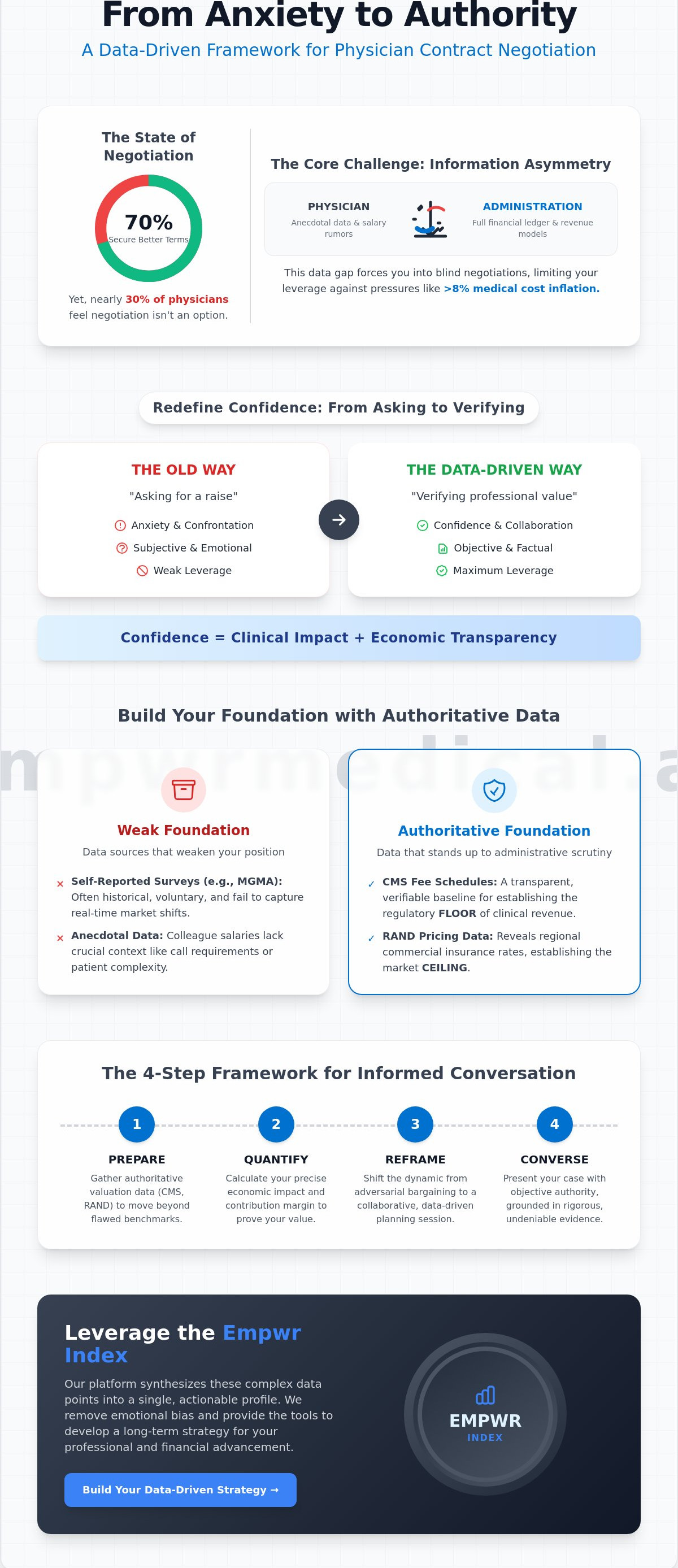
The Informed Conversation: A Step-by-Step Negotiation Framework
The transition from calculation to communication requires a deliberate change in posture. Once you've established your economic baseline, the goal is to lead a data-driven meeting that feels collaborative, not adversarial. Adopting a professional, "quietly confident" tone serves as your most effective tool. It signals that you aren't guessing or making emotional demands. Instead, you're presenting an objective reality. By framing your data as a tool for "strategic planning," you position yourself as a partner interested in the long-term sustainability of the health system. This approach naturally builds physician negotiation leverage because it invites administration to problem-solve alongside you rather than against you.
Timing is critical when introducing independent valuation reports. You shouldn't lead with a report as a "demand" in the first few minutes of a meeting. Use it to anchor the discussion once the conversation moves toward specific compensation figures. This provides a steady reference point that grounds the dialogue in facts. For a detailed roadmap on these interactions, consult the physician’s guide to data-driven contract negotiation.
Framing Your Value Proposition
Effective framing begins by aligning your personal clinical goals with the hospital’s broader mission. If the system is focused on expanding access in a specific subspecialty, highlight how your productivity metrics and contribution margin support that expansion. Presenting your economic value as a "win-win" ensures that administrators see your request as an investment in a high-performing asset. Use declarative phrases that signal authority, such as "Based on my analysis of the CMS fee schedule and current RAND regional benchmarks, the data suggests a market-aligned valuation of..." This language removes the "I want" from the dialogue and replaces it with "The data indicates."
Handling Common Objections with Data
Administrators often rely on standard objections like "the budget is fixed" or "compensation is capped by our internal Fair Market Value (FMV) standards." These are often defensive postures used to maintain the information asymmetry discussed earlier. When faced with these claims, you can counter by presenting your own independent FMV data. Reframing an "excessive" request as a "market-aligned valuation" based on your specific contribution margin changes the math for the administrator. If you can show that your clinical workflow generates a surplus that comfortably covers the requested increase while maintaining regulatory compliance, the "fixed budget" argument loses its logical foundation. Using these metrics ensures your physician negotiation leverage remains intact even when faced with institutional pushback.
To ensure your next contract reflects your true professional impact, you can request a specialty-specific revenue analysis today.
Leveraging the Empwr Index for Long-Term Strategy
While a single successful meeting is a significant win, sustainable physician negotiation leverage is built on a foundation of longitudinal data. The Empwr Index serves as a standardized metric for quantifying physician value, translating complex clinical outputs into a single, authoritative figure. This isn't just a static number; it's a strategic asset that evolves with your career. By utilizing a physician economic value score, you remove the emotional volatility often associated with compensation reviews. You're no longer presenting a personal request. You're presenting a validated, third-party assessment of your professional contribution that is grounded in the operational realities of healthcare finance.
Having your data validated by a third-party, physician-led platform provides a layer of credibility that internal spreadsheets cannot match. It signals to administration that your analysis is objective and follows a rigorous methodology. This external validation acts as a bridge between your clinical world and the hospital's financial world. It ensures that both parties are looking at the same set of hidden truths, which positions you as a high-level professional who values evidence over emotional appeals. This level of transparency is essential for maintaining a sense of fairness in long-term professional relationships.
Using the Empwr Index Report in Real-Time
The Empwr Index Report is designed for immediate impact during contract renewals or mid-cycle reviews. When you present this report to a CFO, you're providing the specific financial language they use to evaluate every other asset in the hospital system. A detailed breakdown of contribution margins carries more weight when it's backed by an external platform. It signals that your data has undergone rigorous analysis and adheres to established industry benchmarks. This transparency reduces the friction typically found in high-stakes professional discussions. By shifting the focus to a standardized score, you make it easier for administrators to approve adjustments that align with your true market value.
Continuous Monitoring of Your Economic Value
Your economic value isn't static. It fluctuates as CMS fee schedules and RAND pricing data shift throughout the year. For example, staying current with 2026 regulatory changes ensures that your valuation remains accurate in a volatile market. Viewing your economic profile as a metric to be monitored annually allows for proactive career planning. Whether you're a mid-career specialist or a senior physician, continuous monitoring ensures you're never negotiating from a position of ignorance. It transforms your career path from a series of reactive events into a controlled, data-driven progression where your physician negotiation leverage is always optimized. This longitudinal approach ensures you're always ready for an informed conversation, regardless of when the opportunity arises.
Transforming Clinical Value into Economic Authority
Replacing negotiation anxiety with objective authority requires a shift from anecdotal comparisons to rigorous, data-driven analysis. By grounding your valuation in authoritative CMS and RAND benchmarks, you move beyond the limitations of self-reported surveys. Quantifying your contribution margin allows you to demonstrate your precise economic impact on a healthcare system, transforming a subjective request into a professional verification of facts. This methodology ensures that your physician negotiation leverage is built on a foundation of transparency and clinical reality rather than administrative assumptions.
Establishing your worth is not a one-time event but a career-long strategy of professional advocacy. Utilizing a physician-led platform designed for specialty-specific revenue modeling provides the clarity needed to lead informed, collaborative conversations at every career stage. When you possess objective proof of your economic value, you can navigate high-stakes discussions with the quiet confidence that comes from being fully prepared. It's time to claim the professional standing your clinical work has earned.
Generate your physician economic value report with Empwr Medical today. Our platform provides specialty-specific revenue modeling and data sourced from CMS and RAND benchmarks to empower your professional advocacy.
Frequently Asked Questions
Is it unprofessional to bring my own financial data to a physician contract negotiation?
Bringing independent data is a hallmark of a sophisticated professional who values transparency and accuracy. Administrators respect objective evidence because it shifts the focus from personal demands to operational realities. Presenting external benchmarks signals that you've done the necessary due diligence to ensure your compensation is both fair and compliant with federal standards. It's an approach that fosters mutual respect rather than conflict.
How do I find my contribution margin if the hospital refuses to share internal financial data?
You can estimate your contribution margin by utilizing public and private data proxies when internal transparency is lacking. By combining your known wRVU production with CMS professional fee schedules and regional RAND pricing, you can build a reliable revenue model. Subtracting standard overhead estimates for your specialty allows you to present a credible margin figure. This external modeling creates significant physician negotiation leverage by filling the information gap.
What is the most common mistake physicians make when negotiating their salary?
The most frequent error is basing a negotiation on anecdotal evidence or the salaries of colleagues. These figures lack the necessary context of payer mix, call burden, and geographic adjustments. When you rely on hearsay, you're forced into a defensive position. A successful strategy requires shifting to a data-driven approach that uses objective benchmarks to verify your specific economic contribution to the health system's bottom line.
Can I use the Empwr Index if I am still a resident or fellow?
Trainees can and should use the Empwr Index to establish a baseline for their initial employment contracts. Entering your first post-training role with a clear understanding of your projected economic value prevents you from leaving money on the table. It sets a professional tone for your entire career. Having a validated score allows you to negotiate with the same authority as an established attending, regardless of your years in practice.
How does geographic location affect my economic value as a physician?
Location significantly impacts your economic value through variations in payer mix and regional reimbursement rates. Rural areas often have higher demand and different commercial insurance benchmarks compared to saturated urban markets. Effective physician negotiation leverage requires using location-adjusted data that reflects these nuances. Generic national averages often fail to capture the specific economic reality of your particular practice environment, leading to inaccurate valuation.
What should I do if the hospital refuses to acknowledge my independent data?
If an administrator dismisses your data, remain focused on the rigor of the methodology and the authoritative sources used. The goal isn't just to win an argument but to define your professional worth and your best alternative to a negotiated agreement. Knowing your objective value gives you the confidence to hold firm or explore other opportunities. This data serves as a North Star, guiding your long-term career strategy even when immediate discussions stall.
Does the Empwr Index account for specialty-specific nuances?
The Empwr Index is built specifically to account for the unique revenue generation patterns of different clinical workflows. Procedural specialties and cognitive specialties differ greatly in how they generate professional and facility fees. Our platform uses specialty-specific revenue analysis to ensure that your score reflects the actual economic impact of your specific field. This granular approach provides the accuracy required for high-stakes contract discussions.
How often should I update my physician economic value score?
You should update your physician economic value score at least once per year or whenever significant market shifts occur. For instance, changes in CMS conversion factors or regional medical cost inflation can alter your valuation overnight. Regular updates ensure your data remains decision-ready for annual reviews or mid-cycle discussions. Monitoring these metrics continuously allows you to maintain a position of strength throughout your professional life.