

Your hospital's favorite benchmark is likely acting as a ceiling for your compensation rather than a reflection of your true economic contribution. In the debate of Empwr Medical vs MGMA, it becomes clear that relying on employer-reported averages can obscure your actual financial impact. You've likely sat through negotiations where administrators used survey percentiles to justify stagnant offers, leaving you feeling undervalued and frustrated by a lack of transparency in how your professional value is calculated.
This analysis demonstrates why traditional surveys might be limiting your negotiation leverage in an era where physician compensation only grew by 3% in 2025. You'll discover how claims-based economic modeling provides a more accurate picture of your worth by focusing on revenue production rather than simple peer averages. We'll preview how moving from wRVU-centric models to specialty-specific revenue analysis gives you the data-backed justification needed to secure higher compensation during your next contract renewal.
Key Takeaways
- Transition from defending your value based on market averages to presenting a case built on your actual clinical revenue contribution.
- Understand the fundamental differences in the Empwr Medical vs MGMA debate, specifically how claims-based modeling eliminates the inherent lag and bias found in employer-reported surveys.
- Identify the "Physician Contribution Margin," a critical metric that reveals the true profit you generate for a system beyond the limitations of the wRVU "black box."
- Master a two-step negotiation strategy that uses administrative benchmarks to identify the market ceiling while establishing your own data-backed revenue floor.
- Gain the strategic leverage necessary to secure a compensation package that reflects your objective professional worth in the 2026 healthcare economy.
Understanding the Shift: MGMA Benchmarks vs. Empwr Medical
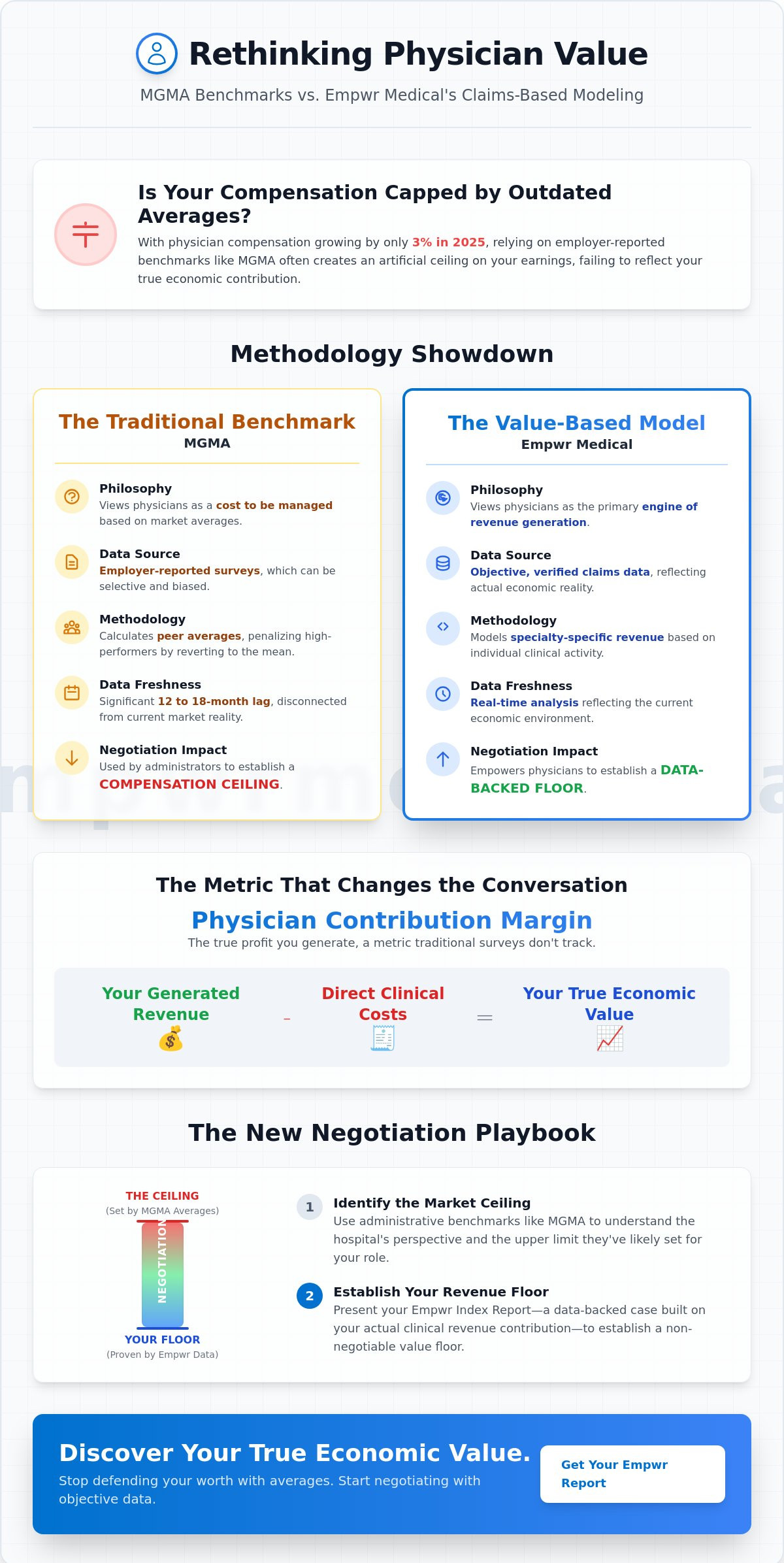
For decades, the Medical Group Management Association (MGMA) has served as the primary source for benchmarking physician pay. Administrators rely on these surveys to establish "fair market value," but this approach often treats physicians as costs to be managed rather than assets that generate revenue. The debate of Empwr Medical vs MGMA isn't just about different numbers; it's about a fundamental shift in philosophy. While MGMA provides a snapshot of what hospitals report paying, Empwr Medical uses claims-based modeling to reveal the actual economic value a physician brings to the table. Physician compensation in the United States is a complex landscape shaped by historical averages and regional trends, yet the 2026 economic environment demands more granular transparency. Relying on "market rates" alone can lead to significant under-valuation, especially for high-performers who exceed the average productivity of their peers.
The Role of MGMA in Hospital Administration
Administrators use MGMA DataDive to set caps on salary offers, often framing these averages as non-negotiable limits. Because this data is self-reported by group managers and hospital executives, it naturally reflects an employer-centric perspective. This creates a systemic disadvantage for clinicians during contract renewals. The survey lag effect occurs because the data collected is typically 12 to 18 months old by the time it reaches a negotiator's desk. In a rapidly changing economy where inflation and specialty-specific demand fluctuate, these stagnant benchmarks fail to capture the current reality of the market. This lack of real-time accuracy makes it difficult for physicians to argue for raises that keep pace with their actual output.
The Empwr Medical Philosophy: Physicians as Value Creators
Empwr Medical views the physician as the primary engine of healthcare revenue. Instead of asking what the average doctor in a specific zip code earns, the platform asks how much revenue a specific clinician’s work generates for the facility. This physician-led approach ensures that clinical nuances, such as procedural complexity and patient acuity, are integrated into the financial model. By utilizing our Physician Economic Value Platform, clinicians can move beyond the "black box" of hospital accounting. The Empwr Index Report serves as a modern alternative to stagnant benchmarks, providing a "value floor" based on objective revenue data. This empowers physicians to enter negotiations with the confidence that their requests are backed by rigorous economic modeling rather than just administrative surveys.
- MGMA Focus: Employer-reported averages and "Fair Market Value" caps.
- Empwr Medical Focus: Objective revenue generation and individual economic contribution.
- Key Outcome: Transitioning from a passive recipient of "market rates" to an active negotiator of professional value.
Methodology Showdown: Survey Data vs. Claims-Based Revenue Modeling
The fundamental difference in the Empwr Medical vs MGMA comparison lies in how the underlying data is harvested and verified. MGMA utilizes an employer-reported model where medical group administrators voluntarily submit compensation and productivity figures. This creates a significant "incentive gap." Administrators are tasked with managing labor costs, which means they have a financial interest in reporting data that supports lower "market rate" arguments. When a hospital system submits its data, it often selectively excludes high-earning outliers or specific bonus structures, leading to a skewed representation of what a physician's work is actually worth in the open market.
Empwr Medical bypasses these subjective reports by analyzing objective claims data. Our methodology relies on a Specialty-Specific Revenue Analysis that tracks the direct relationship between clinical activity and reimbursement. By examining the actual flow of funds from payers to providers, we establish a valuation based on economic reality rather than administrative consensus. This approach aligns more closely with professional standards, such as IRS valuation methodologies for medical practices, which emphasize income-based approaches to determine fair value.
The Transparency Problem in Traditional Surveys
Traditional benchmarks suffer from a "reversion to the mean" that penalizes high-performers. Many physician compensation survey limitations stem from small sample sizes in niche sub-specialties. If only a few dozen pediatric neurosurgeons in a specific region report their data, the resulting "average" is statistically fragile. Conversely, Empwr Medical uses cms data for physician compensation to ensure 100% transparency. This allows for a location-adjusted view that accounts for regional variations in fee schedules and cost-of-living adjustments without relying on the honesty of a competing hospital's HR department.
The Power of RAND Pricing and Claims Data
Understanding your value requires looking beyond Medicare rates. We integrate how to use rand pricing data for physicians to provide a clear window into private payer multiples. This data allows us to translate your specific CPT codes into detailed revenue estimates. When you present a claims-based model during a negotiation, you aren't just offering "another survey." You're presenting a verifiable audit of the revenue you generate. This level of granularity is significantly harder for administrators to dismiss because it's rooted in the same financial logic they use to calculate their own profit margins. To see how your specific workflow translates into revenue, you can request a custom Empwr Index Report to anchor your next conversation in objective fact.
- MGMA: Relies on administrative honesty and historical averages.
- Empwr Medical: Analyzes CPT-level claims and private payer multiples.
- Result: A shift from "What do others get?" to "What do I produce?"
Contribution Margin: The Metric MGMA Doesn’t Track
Most discussions regarding Empwr Medical vs MGMA eventually collide with a single, often ignored reality: the difference between effort and profit. MGMA benchmarks focus heavily on compensation percentiles and wRVU targets, which are metrics of labor and volume. However, these figures fail to account for the Physician Contribution Margin. This metric is defined as the total revenue a physician generates minus the direct variable costs associated with their practice. While a hospital might use survey data to argue that your salary is "at market," they rarely volunteer the data showing the actual profit your clinical activity contributes to their bottom line. By focusing on margin rather than just salary averages, you gain a clearer understanding of your strategic importance to the organization.
The Physician Economic Value Platform is designed to bridge this information gap. It moves beyond the administrative "black box" of hospital accounting to show the tangible financial impact of your work. The contribution margin reveals the hidden profit in physician services by isolating the specific income you produce after accounting for the expenses you directly control. This level of clarity is essential for any clinician who wants to move the conversation from "What is the average pay?" to "What is the return on investment for my presence in this system?"
Beyond wRVUs: Why Volume is Not Value
Many physicians fall into the physician relative value units explained trap, where they believe that increasing their wRVU output will naturally lead to fair compensation. This isn't always the case. wRVUs measure clinical effort, but they don't account for the actual reimbursement rates or the downstream value you create for the hospital. For instance, a primary care physician might have a lower direct margin than a surgeon, but their referrals drive significant revenue for imaging and laboratory departments. MGMA benchmarks ignore these downstream ripples, treating every clinician as an isolated cost center rather than a revenue engine. Our Empwr Index Report quantifies this broader clinical impact, providing the data needed to show that your value extends far beyond simple volume metrics.
Quantifying Your Strategic Impact
Defending your compensation requires a Specialty-Specific Revenue Analysis that accounts for your unique role within the health system. Consider the leverage difference between a primary care provider and a sub-specialist. A primary care doctor has immense leverage through the "top-of-funnel" revenue they generate for the system, while a specialist may have higher direct procedural margins. Both need to use specialty specific revenue analysis to prove their ROI to the board. When you can demonstrate that your contribution margin significantly exceeds your total compensation package, you aren't just asking for a raise; you're presenting a data-backed business case for your value. This shift in perspective is what allows for more informed, objective conversations during contract renewals.
- wRVUs: A measure of work performed, not revenue earned.
- Contribution Margin: The actual profit remaining after direct costs.
- Empwr Index: A comprehensive score of your total economic impact.
The Negotiation Playbook: Integrating Empwr Data with MGMA
Effective negotiation requires understanding the administrator's playbook while executing your own with superior data. In the context of Empwr Medical vs MGMA, the goal isn't to dismiss traditional benchmarks entirely, but to use them as a starting point. By integrating these two data sources, you can move away from defensive posturing and toward a strategy of data-backed professional advocacy. This approach allows you to acknowledge the hospital's "market rate" while establishing an objective floor based on the revenue you actually produce.
To execute this strategy, follow these five steps during your next contract renewal:
- Step 1: Obtain the specific MGMA percentiles the hospital is using. This identifies their perceived "ceiling" for your specialty and region.
- Step 2: Generate an Empwr Index Report. This provides the "revenue floor" by modeling your actual clinical output against current CMS and private payer rates.
- Step 3: Identify the Value Gap. This is the difference between the hospital's reported average and the objective economic value of your services.
- Step 4: Present your findings as a validation of Fair Market Value (FMV). Use authoritative CMS and RAND sources to show that your request is rooted in economic reality.
- Step 5: Frame the conversation around mutual strategic growth. Show how aligning your compensation with your revenue generation incentivizes continued high performance and system stability.
Handling the "FMV Compliance" Objection
Administrators often use "compliance" as a shield to shut down negotiations. They may claim that paying above a certain MGMA percentile risks violating federal regulations. You can counter this by providing physician fair market value data from multiple sources. Relying on a single survey is actually a riskier move for compliance teams than using a multi-source approach. Positioning Empwr data as a "sanity check" against biased or lagging surveys helps the hospital justify a higher compensation tier while remaining within legal boundaries. It demonstrates that you're not asking for an arbitrary number, but rather a rate supported by 100% transparent claims data.
Winning the "Informed Conversation"
Successful negotiations are built on clarity rather than emotional appeals. Bringing a physician economic value score to the table gives you a significant psychological advantage. It shifts the power dynamic from an employee asking for a raise to a high-level professional discussing a business partnership. This score can be used to justify not only your base salary but also requests for additional staff support, better equipment, or protected clinical time. When you quantify your impact, you make it easier for the board to see you as a revenue engine rather than a cost center. To begin building your data-backed case, you can access your custom Empwr Index Report today.
Choosing the Right Tool for Your 2026 Strategy
Deciding between Empwr Medical vs MGMA depends entirely on your specific objective. MGMA remains a useful resource for administrators who need to analyze high-level practice management trends or broad administrative staffing benchmarks. It provides a wide-angle view of how medical groups function across the country. However, if your goal is personal advocacy or securing a contract that reflects your individual revenue production, you need a different level of precision. Administrative surveys provide the context of the room, but they don't tell the story of the individual clinician sitting at the table.
The most effective negotiators use both datasets in tandem to build a comprehensive case. MGMA defines the common language used by hospital HR departments, while our Physician Economic Value Platform provides the verifiable evidence of your specific worth. This synergy creates a 360-degree view of your value that's difficult for any board to ignore. As the healthcare industry moves toward greater transparency, the reliance on claims-based reality will become the standard for high-level professional agreements. Moving forward, the most successful physicians will be those who can speak both the language of market averages and the language of objective revenue.
Empwr Medical: Designed for the Individual Physician
Most hospital-provided reports are designed to serve the system's financial interests, often obscuring the direct link between your work and their revenue. Empwr Medical translates complex "hospital-speak" into a clear narrative of physician value. By utilizing continuous updates from CMS fee schedules and RAND pricing data, the platform ensures your data stays accurate throughout the year, even as market conditions shift. This level of detail is vital because quantifying physician value is the most important career move you can make in 2026. It protects you from the lag time inherent in annual surveys and gives you a real-time understanding of your economic leverage.
Final Verdict: Market Average or Personal Value?
You shouldn't settle for being treated as a market average when your clinical output is exceptional. Relying on outdated surveys often means leaving money on the table; money that the health system is already collecting as a direct result of your clinical expertise. The strategic advantage of our Specialty-Specific Revenue Analysis is its ability to turn complex billing data into a simple, undeniable business case for your compensation. It shifts the burden of proof from you to the administration, forcing them to reconcile their "market rate" arguments with the revenue reality you provide.
Don't walk into your next contract review with only half the story. To see the full economic reality of your clinical practice and secure the compensation you've earned, Generate your Empwr Index Report today and take control of your professional future.
Securing Your Economic Future in 2026
The landscape of physician compensation is shifting toward a model of objective transparency. Relying on a "market average" is no longer a viable strategy for high-level professionals who want their pay to reflect their actual clinical output. By understanding the nuances of Empwr Medical vs MGMA, you can navigate your next contract renewal with the confidence of knowing your precise economic contribution. This transition from passive recipient to data-driven advocate is essential for long-term career stability and professional satisfaction.
Our platform is physician-founded and led, ensuring that clinical accuracy is never sacrificed for administrative convenience. By utilizing authoritative CMS and RAND data sources, we provide specialty-specific revenue modeling that uncovers the hidden value in your professional workflow. It's time to stop guessing and start quantifying your impact with the same precision you bring to patient care. You've dedicated your career to clinical excellence; your compensation should reflect that same level of rigor and dedication.
Access your Physician Economic Value Platform and reclaim your leverage
Frequently Asked Questions
Is Empwr Medical data considered valid for Fair Market Value (FMV) determinations?
Yes, Empwr Medical data is valid for FMV determinations because it's rooted in objective, third-party revenue data. In the debate of Empwr Medical vs MGMA, relying solely on a single survey is often riskier for compliance teams than using a multi-source approach. By incorporating claims-based modeling from CMS and RAND, you provide a more robust justification for compensation that reflects actual economic contribution rather than an administrative average.
How does Empwr Medical differ from traditional salary surveys like MGMA?
The primary difference in the Empwr Medical vs MGMA comparison is the source of the data. MGMA relies on self-reported surveys from hospital administrators, which are often subject to reporting bias and significant time lags. Empwr Medical uses a Physician Economic Value Platform to model revenue directly from claims data and fee schedules. This shift moves the focus from what others are paid to what you actually produce.
Can I use Empwr Medical data if my hospital only recognizes MGMA?
You can absolutely use Empwr data even if your hospital claims to only recognize MGMA. Presenting multiple data points is a standard practice in professional valuations and actually strengthens the hospital's compliance case. Use the MGMA figures to understand their perceived ceiling and your Empwr Index Report to establish your revenue floor. This creates a more informed conversation based on objective financial reality rather than administrative consensus.
What data sources does Empwr Medical use to calculate physician revenue?
Empwr Medical utilizes a combination of CMS fee schedules, RAND pricing data, and specialty-specific CPT code analysis. By examining the actual reimbursement rates from both public and private payers, the platform creates a highly accurate Specialty-Specific Revenue Analysis. This methodology ensures that your valuation is based on the current economic environment rather than historical survey data that may no longer be relevant to your specific clinical practice.
Does Empwr Medical account for geographic differences in physician pay?
Yes, the platform provides location-adjusted data to account for regional variations in cost of living and payer mixes. Economic reality in a major metropolitan area differs significantly from rural practice environments. Our modeling ensures that your professional value is quantified using granular, geographic-specific nuances. This allows for a more precise negotiation that reflects the specific financial conditions and reimbursement patterns of your local healthcare market.
How often is the data in the Empwr Medical platform updated?
Data within the platform is updated continuously as new CMS fee schedules and RAND pricing reports become available. Unlike traditional surveys that only release data once a year, our Physician Economic Value Platform reflects real-time shifts in the healthcare economy. This eliminates the 12 to 18 month lag common in other benchmarks, ensuring you always have the most current data for your contract discussions and strategic planning.
Is Empwr Medical useful for residents and fellows entering their first contract?
Empwr Medical is highly useful for residents and fellows who don't yet have a long history of production data. By modeling the expected revenue impact of your specific specialty and location, the platform helps you understand your worth before you sign your first contract. This prevents new physicians from being anchored to low entry-level rates that don't reflect their true economic potential to a health system.
What is the "Empwr Index" and how is it calculated?
The Empwr Index is a proprietary score that quantifies your total clinical impact by calculating your contribution margin. It's derived by taking the total revenue your work generates and subtracting the direct variable costs associated with your practice. This score provides a single, clear metric that translates your clinical effort into economic terms, making it easier to prove your ROI during high-level professional negotiations with hospital boards.