

While the average physician compensation reached $387,261 in 2026, many practitioners still find themselves trapped by an outdated metric: the wRVU. If you feel like a commodity in a consolidated health system, you're not alone. It's frustrating to know your clinical expertise generates significant downstream revenue while your physician performance review negotiation remains tethered to a narrow definition of productivity.
We understand that the lack of transparency in hospital financial reporting makes it difficult to advocate for yourself. You deserve compensation that aligns with your true Fair Market Value, not just a volume-based quota. This article provides a clear framework to help you translate your clinical workload into health system revenue, giving you the data-backed confidence needed to lead a successful negotiation.
We'll examine how to calculate your specific economic value, account for the 2026 Medicare Physician Fee Schedule changes, and shift the conversation from simple output to total financial contribution.
Key Takeaways
- Understand why clinical excellence is now a baseline expectation and how to pivot your professional narrative toward economic contribution.
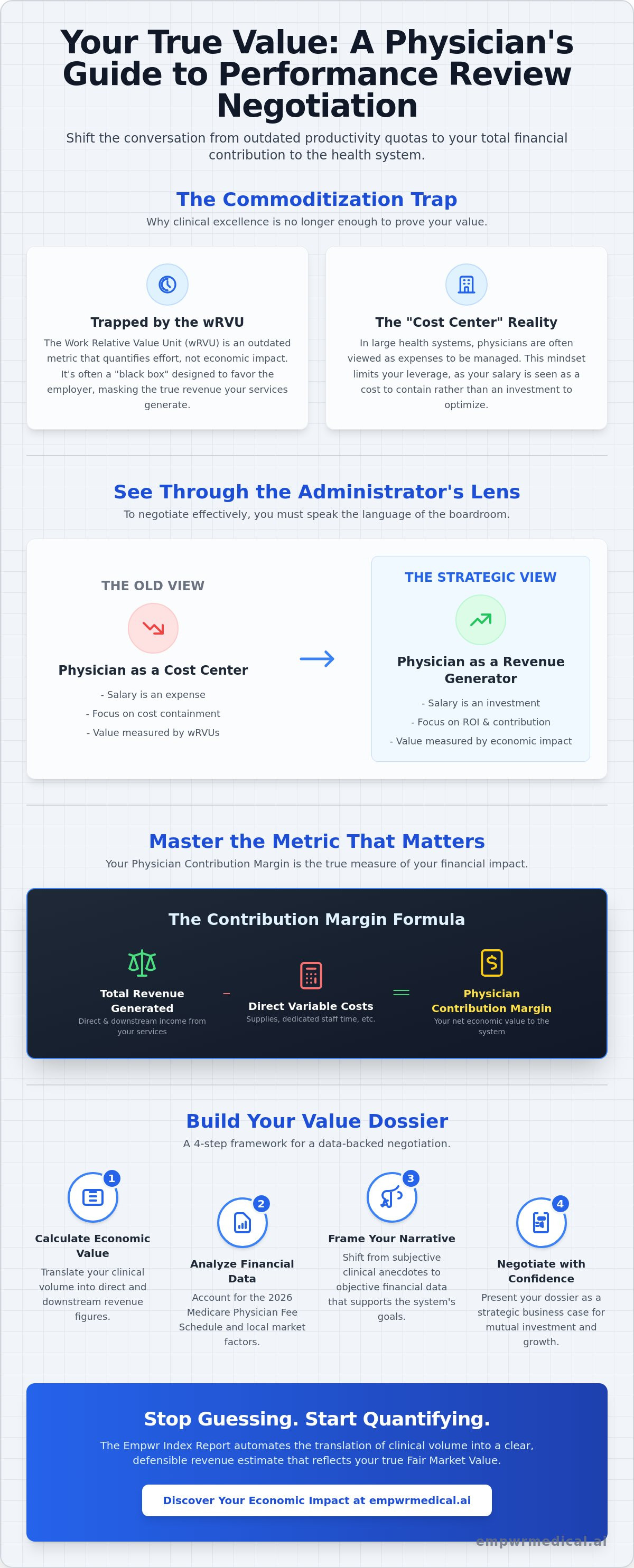
- Move beyond the limitations of the wRVU to calculate your Physician Contribution Margin, revealing the direct revenue you generate for the health system.
- Master a step-by-step framework for building a Value Dossier to lead a data-backed physician performance review negotiation with quiet confidence.
- Learn to frame your performance review as a strategic business meeting that presents objective financial data without appearing adversarial to administration.
- Discover how the Empwr Index Report automates the translation of clinical volume into revenue estimates that reflect your true Fair Market Value.
Why Clinical Excellence is No Longer Sufficient to Prove Your Value as a Physician
For decades, the physician-patient relationship served as the primary metric of professional success. That paradigm has shifted. As private practices merge into massive health systems, the role of the physician has evolved from an independent partner to an employed professional. In the eyes of modern hospital administration, this often translates to being viewed as a "cost center." It's a sobering reality that requires a strategic response. If your salary is viewed solely as an expense to be managed rather than an investment to be optimized, your leverage in any negotiation is inherently limited.
Clinical outcomes and patient satisfaction scores, once considered differentiators, are now viewed as baseline expectations. They're the "table stakes" of modern medicine. When every physician in the system meets these high standards, individual value becomes blurred. This is the commoditization trap. To avoid being treated as a fungible asset, you must shift your mindset from being a clinical practitioner to becoming a strategic economic partner. Success in a physician performance review negotiation now depends on your ability to articulate your value in the language of the boardroom.
The Problem with the "Good Doctor" Argument
Relying on the "good doctor" narrative during a physician performance review negotiation is a high-risk strategy. Administrators prioritize institutional financial sustainability over clinical anecdotes. There's often a significant disconnect between high-quality clinical care and actual hospital reimbursement models, such as pay-for-performance (P4P) initiatives. While P4P aims to reward quality, the financial reality is that hospitals need more than just "good" metrics to remain solvent. You must move toward quantifying physician value to demonstrate exactly how your practice patterns support the health system’s bottom line. Objective data bridges the gap between clinical excellence and financial viability.
Understanding the Administrator’s Perspective
Health system leadership evaluates physician "ROI" through a lens of operational efficiency and revenue generation. In 2026, they're focused on KPIs like contribution margin, throughput, and downstream referrals. Utilizing a physician financial impact analysis for hospitals allows you to speak their language. When you understand the financial pressures keeping CEOs awake, you can frame your contributions as solutions to their most pressing budgetary problems. This level of insight transforms the negotiation from a request for more money into a collaborative discussion about strategic investment. Clarity regarding your economic impact is the only way to secure compensation that aligns with the reality of your contribution.
Mastering the Metrics: Moving Beyond wRVUs to Economic Impact
Health systems often utilize the work Relative Value Unit (wRVU) as the primary yardstick for productivity. While this metric quantifies clinical effort, it fails to capture the actual financial health of a practice. The wRVU conversion factor is essentially a "black box" designed to favor the employer, masking the true revenue generated by your services. To prepare for a successful physician performance review negotiation, you must look deeper into the institutional data. Relying on the same metrics provided by your employer ensures the conversation remains on their terms.
Contribution Margin is the net income a physician generates for the system after direct expenses. This figure provides a much clearer picture of your institutional worth than wRVUs alone. By subtracting direct variable costs, such as medical supplies and dedicated clinical staff time, from your total generated revenue, you reveal your true Physician Contribution Margin. This calculation is the foundation of a data-driven advocacy strategy.
wRVUs vs. Contribution Margin: The Critical Difference
Relying solely on MGMA benchmarks can be misleading. These standards often lack granular, local geographic adjustments, leading to skewed comparisons that don't reflect your specific market. A high wRVU count doesn't always correlate to a profitable practice if the associated overhead is disproportionately high. Transitioning your focus toward physician economic profiling allows you to analyze your value based on actual financial outcomes rather than simple productivity counts. This shift aligns with a new way to approach physician performance reviews that prioritizes economic transparency over volume-based effort.
Capturing Downstream and Indirect Value
Your value isn't limited to the procedures you personally perform. Every referral for imaging, lab work, or physical therapy contributes to the hospital’s bottom line. This "halo effect" represents significant downstream revenue, including surgical facility fees, that administrators often omit from standard performance summaries. Quantifying your role in keeping patient leakage low is equally vital. By retaining patients within the system, you protect the organization's market share and overall financial stability. If you're looking for a clearer picture of these figures, reviewing a specialty-specific revenue analysis can provide the necessary baseline for your discussion.
Don't overlook the economic value of your non-clinical contributions. Leadership roles, teaching residents, and administrative committee work all have a quantifiable impact on operational efficiency and institutional prestige. When these indirect values are aggregated, they form a comprehensive picture of your professional worth. A physician performance review negotiation that includes these data points is far more likely to result in compensation that reflects your total contribution to the system.
The Value Dossier: A Step-by-Step Framework to Prove Your Value
A successful physician performance review negotiation requires more than a list of clinical achievements. It demands a structured Value Dossier that translates your daily work into the institutional language of revenue and margin. This document serves as your objective proof of contribution, moving the conversation away from subjective impressions and toward financial reality. By following a methodical framework, you can build a dossier that administrators cannot easily dismiss. It's about replacing emotional appeals with the steady assurance of data.
Step 1: Gathering Your Clinical Evidence
Your first task is to aggregate 12 months of comprehensive productivity data. This includes total patient encounters, specific CPT codes, and your current payer mix. Don't rely solely on the summaries provided by your department. Instead, request detailed billing reports to cross-reference your internal records. Focus on identifying high-margin procedures or services that drive significant profitability for the health system. This granular level of detail ensures your data is accurate and defensible under scrutiny. When you know exactly what you've billed and what's been collected, you hold the keys to the conversation.
Step 2: External Benchmarking and Validation
Once you've gathered your clinical data, you must validate it against external standards. Utilizing physician fair market value data provides the strongest leverage during your meeting. Use authoritative sources like the CMS fee schedule to bypass hospital-specific data that might be biased toward the employer's interests. Additionally, applying RAND pricing data helps you account for private payer variations, giving you a more realistic estimate of the revenue you generate. This step is critical because it removes the "black box" element from the physician performance review negotiation, forcing a discussion based on national benchmarks rather than internal myths.
After validating your data, you must factor in specialty-specific workflows and geographic cost adjustments. A surgeon in a high-cost metropolitan area has a different economic profile than a primary care physician in a rural setting. Precision here is vital to maintain credibility. To organize these complex data points, prepare a physician value proposition template before your meeting. This template acts as your roadmap, ensuring every financial contribution is clearly articulated and benchmarked against national standards. This systematic approach ensures that you aren't just asking for a raise; you're presenting a business case for a market-rate adjustment based on documented economic impact.
Physician Performance Review Negotiation: Strategies for Data-Backed Advocacy
The most effective way to enter a physician performance review negotiation is to treat the encounter as a strategic business meeting rather than a standard HR check-in. This subtle shift in framing changes the power dynamic. By setting a clear agenda that prioritizes financial transparency, you position yourself as a partner in the system’s success. Presenting your Value Dossier should feel like a collaborative review of shared goals. You aren't there to demand more; you're there to ensure your compensation reflects the objective economic reality of your clinical contributions.
Administrators often rely on standardized objections to contain costs. When you hear that "the budget is frozen" or that "you're already at the 75th percentile," use the Informed Conversation technique. Instead of accepting these claims at face value, ask clarifying questions about how the system utilizes the specific margin you generate. If your compensation is capped at a certain percentile, but your revenue generation is in the top decile, there's a clear misalignment that data can resolve. This approach forces a discussion based on your actual impact rather than arbitrary institutional limits.
Navigating the "Black Box" of Hospital Accounting
It's common for administrators to claim they "don’t track" specific margins for individual physicians. This lack of transparency is often a tactical choice to maintain leverage. When faced with this "black box," use your own revenue analysis to challenge vague financial claims. By presenting your own data on CPT volumes and payer-specific reimbursements, you remove their ability to hide behind administrative complexity. You're no longer saying "I need a raise"; you're stating "I am generating X in net revenue, and a market-rate adjustment to Y is mathematically justified."
Leveraging Your Economic Value Score
Objective validation is the cornerstone of quiet confidence. Utilizing a physician economic value score provides a third-party benchmark that administrators find difficult to ignore. An economic value score provides a standardized metric for professional worth. This single, authoritative index simplifies the negotiation by providing a clear reference point for both parties. It removes the emotional weight of the request and replaces it with a rigorous, data-driven standard. To secure this level of clarity before your next meeting, you can access your own data through the Physician Economic Value Platform.
Quantifying Your Impact with Empwr Medical’s Economic Value Platform
Empwr Medical’s Economic Value Platform serves as the technological bridge between your clinical reality and the health system’s financial ledger. While manual data collection is possible, the platform automates the creation of your Value Dossier by integrating complex datasets that most physicians simply don't have time to parse. By utilizing the Empwr Index, the platform translates your specific clinical workload into precise revenue estimates based on CMS and RAND benchmarks. This ensures your physician performance review negotiation is grounded in objective truth rather than the internal benchmarks often manipulated by hospital administrators. The platform acts as an interpreter, turning raw billing data into a clear narrative of institutional impact.
Physician-led data is inherently more trustworthy than administrator-led surveys because it removes the conflict of interest present in hospital-funded reporting. Internal hospital reports frequently rely on proprietary accounting methods that favor the employer by obscuring true contribution margins. In contrast, the platform uses standardized, transparent methodology that stands up to executive scrutiny. This level of rigor is essential for preparing for your next physician contract negotiation, allowing you to enter the room with the steady assurance that your numbers are accurate, location-adjusted, and defensible.
Specialty-Specific Revenue Analysis
Multi-specialty groups present a unique challenge because the economic contribution of a surgeon differs fundamentally from that of a primary care physician. A specialty specific revenue analysis accounts for these nuances, including unique procedural workflows and specific ancillary revenue streams like imaging or pathology. For instance, recent data indicates that cardiology practices often generate significant downstream revenue that is frequently omitted from standard wRVU reports. By presenting a report that included these hidden revenue streams, physicians have successfully secured compensation adjustments that align with their actual financial contribution during a physician performance review negotiation.
Continuous Valuation vs. Annual Reviews
Waiting for an annual review to understand your worth creates unnecessary professional risk. Monitoring your economic value year-round prevents "review-day surprises" and allows you to track payer mix shifts in real-time as they occur. As the 2026 Medicare Physician Fee Schedule introduces separate conversion factors for APM participants ($33.5675) and non-APM participants ($33.4009), staying informed is more critical than ever. SaaS tools provide the clarity needed to adjust your strategy as reimbursement models evolve and market conditions shift. This continuous monitoring transforms your value from a once-a-year question into an ongoing strategic asset.
Ready to see your true numbers? Start your Empwr Index Report today.
Secure Your Market Value with Data-Driven Clarity
Success in a modern health system depends on your ability to articulate your contribution in financial terms. By transitioning from a focus on clinical volume to a clear understanding of your contribution margin, you regain control over your professional narrative. You've learned how to construct a Value Dossier that bypasses subjective opinions and relies on the steady assurance of objective benchmarks. This methodical approach ensures your worth is no longer a matter of administrative discretion but a documented reality.
Mastering the physician performance review negotiation requires a fundamental shift in perspective. You're not just a clinician; you're a strategic economic partner. To ensure your compensation aligns with your true Fair Market Value, you need data that is as rigorous as your clinical practice. Empwr Medical was built by physicians for physicians to provide this level of transparency. Our platform utilizes authoritative CMS and RAND data sources to generate location-adjusted and specialty-specific reports that reveal the hidden truths of your practice revenue.
Calculate Your True Economic Value with Empwr Medical and enter your next review with the quiet confidence that only data can provide. You have the clinical expertise; now you have the economic evidence to back it up.
Frequently Asked Questions
How do I prove my value as a physician beyond wRVUs?
You prove your value by quantifying your impact on the health system's total financial health rather than just clinical effort. This involves tracking downstream revenue, such as imaging referrals, lab work, and surgical facility fees, which are often excluded from standard productivity reports. Demonstrating your role in reducing patient leakage and maintaining institutional market share provides a more comprehensive picture of your professional worth.
What is a physician contribution margin and why does it matter for negotiation?
Physician contribution margin is the net income you generate for a health system after subtracting direct variable costs, such as medical supplies and dedicated clinical staff time. It matters because it reveals your actual profitability to the organization. Unlike wRVUs, which only measure volume, the contribution margin provides a transparent financial metric that justifies compensation based on the revenue you actually produce.
Can I negotiate my salary during an annual physician performance review?
Yes, you can negotiate your salary during an annual review if you frame the encounter as a strategic business meeting. While administrators often view these as routine clinical check-ins, presenting a data-backed Value Dossier allows you to pivot the conversation toward compensation. Using objective evidence of your economic impact makes it difficult for leadership to dismiss your request for a market-rate adjustment.
What data should I bring to a physician contract renewal negotiation?
You should bring 12 months of clinical volume data, including specific CPT codes and your current payer mix. This internal data should be cross-referenced with external benchmarks from the CMS fee schedule and RAND pricing data. Having these figures ready ensures that your physician performance review negotiation is based on defensible revenue estimates rather than the hospital's internal accounting myths.
How do I handle it if my hospital says they use MGMA data and won’t budge?
Challenge the hospital's reliance on broad benchmarks by introducing location-adjusted and specialty-specific data. MGMA averages often lack the granularity needed to reflect your specific market's economic realities. By presenting a more precise economic profile, you force the conversation away from national generalizations and back to your specific financial contribution to the local health system.
Is it possible to calculate my own economic value without hospital data?
It is entirely possible to calculate your economic value using your personal billing records and authoritative external sources. By applying the CMS fee schedule and RAND pricing benchmarks to your documented CPT volumes, you can generate an independent revenue estimate. This allows you to enter negotiations with a clear understanding of your worth, even if the hospital refuses to provide transparent financial reports.
What are the most common mistakes physicians make during performance reviews?
The most common mistake is relying on emotional appeals or clinical anecdotes instead of objective financial data. Many physicians enter reviews without a structured framework, making them vulnerable to standard administrative objections about budget freezes. Failing to quantify downstream revenue or leadership value often results in compensation that doesn't reflect the physician's total economic impact on the organization.
How does the Empwr Index help in physician performance review negotiation?
The Empwr Index provides a standardized, third-party metric that quantifies your professional worth based on rigorous methodology. It simplifies the physician performance review negotiation by translating complex clinical workflows into a single, authoritative score. This index acts as an objective validator, providing a defensible baseline for compensation discussions and ensuring your value is recognized by hospital leadership.